
An Introduction to Stoic Project Management

Every project manager has lived through that moment: the timeline slips, a key stakeholder sends a pointed email at 5 PM on a Friday, and/or the scope has quietly expanded beyond what anyone agreed to. You feel the pressure rising. Your next move, reactive or measured, defines not just the project, but your renown as a leader. And reputation in this game is everything.
Most project management training focuses on tools, processes, and frameworks, yet offers limited preparation for managing people, ethics, and expectations. This is precisely where Stoic philosophy becomes relevant.
Around 300 BCE, a merchant named Zeno of Citium suffered a shipwreck off the coast of Athens and lost nearly everything. Rather than rebuild his trading business, he walked into a bookshop, became fascinated by philosophy, and eventually began teaching in the covered walkway known as the Stoa Poecile. What he started there, a school of practical philosophy built on reason, virtue, and the discipline of focusing only on what you control, became Stoicism. Over four centuries later, it would influence the private journal of a Roman emperor managing an empire under constant pressure. It has been silently shaping great leaders ever since; e.g., Marine Major General James Mattis, Warren Buffett, and Vice Admiral James Stockdale credited Epictetus directly with giving him the mental framework to survive seven and a half years as a Prisoner of War in the Hanoi Hilton, arguably the most powerful modern testimony to Stoicism under extreme pressure.
This post serves as an introduction to The Stoic PM and outlines why the ancient practice of Stoicism may represent the most practical enhancement for contemporary project managers.
What Is Stoicism, Really?
Stoicism does not advocate suppressing emotion, enduring hardship without acknowledgment, or ignoring problems. Instead, it is a practical philosophy developed in ancient Greece and refined in Rome by thinkers such as Marcus Aurelius, Epictetus, and Seneca. Fundamentally, Stoicism emphasizes directing energy toward areas where it can yield results and relinquishing concern for matters beyond one's control.
Focus your energy where it produces results and release your grip on everything else.
Marcus Aurelius governed the Roman Empire while contending with wars, political opposition, plagues, and personal loss. He maintained a private journal, now known as Meditations, as a daily exercise in self-examination rather than for publication. His writings reflect a leader addressing complex, high-stakes challenges in real time.
Epictetus, a former slave who became one of the most influential teachers of his era, framed the entire philosophy in a single idea: some things are in our power, and some are not. Everything he taught flows from that distinction.
Some things are in our power, and some are not.
That idea is the foundation of The Stoic Project Manager.
The Dichotomy of Control is The PM's Most Useful Tool
Over 2,000 years ago, Epictetus opened his handbook, The Enchiridion, with a deceptively simple idea, "Some things are in our power, and some are not." Modern philosophers call this the dichotomy of control. Project managers might call it the most useful filter they have never been formally taught.
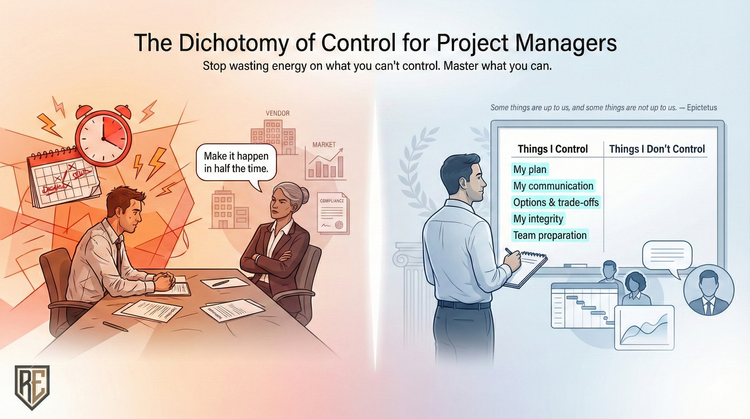
The concept is simple, really: every situation you face as a project manager falls into two categories. The first is what you can directly influence through your own judgment, effort, and choices. The second is everything outside that. Examples include other people's decisions, external events, organizational politics, and market forces. The Stoic discipline is learning to pour your energy into the first category and release your grip on the second. Not because the second category does not matter, but because anxiety about it produces no useful output.
Here is how that split looks in practice:
What you control:
- How you plan and communicate [how you write]
- The clarity of your requirements and scope documentation [how you think]
- How you respond to setbacks, conflict, and ambiguity [your disposition]
- The quality of your risk thinking and contingency planning [your risk analysis]
- Your own attitude, preparation, and follow-through [your temperament]
What you do not control:
- Whether a vendor delivers on time
- How a stakeholder reacts to bad news
- Budget freezes, executive decisions, or team turnover
- Market shifts that change project priorities overnight
- The planning fallacy is built into human optimism (more on that in our post on The Optimism Trap,)
When project managers expend mental energy on factors beyond their control, decision quality declines, and leadership presence diminishes. Teams and stakeholders perceive this shift. The Stoic project manager distinguishes clearly between controllable and uncontrollable elements, acting decisively only within the former.
This approach does not constitute passivity; rather, it reflects precision.
The Four Virtues in a Project Setting
Stoicism is also built around four core virtues: Wisdom, Courage, Justice, and Temperance. These are not intangible principles. For a project manager, they are behavioral anchors.
Wisdom is the ability to see a situation clearly, without wishful thinking or panic distorting your judgment. It shows up when you assess risk honestly, challenge unrealistic timelines, and make decisions based on evidence rather than pressure.
Courage is acting on what you know to be right, even when it is uncomfortable. It takes courage to tell a sponsor that their pet project is underfunded (or it is just a bad idea). It takes courage to escalate a risk before it becomes a crisis, knowing the message will not be welcome. Courage in project management work is not dramatic; it is quiet, consistent, and honest.
Justice governs how you treat your team, your stakeholders, and your collaborators. A Stoic PM leads fairly by giving credit where it is due, holding people accountable without humiliating them (I recently wrote a three-page paper for school on this), and making decisions that consider the whole team rather than selfish convenience.
Temperance is the discipline to stay measured. It is the virtue that keeps you from over-committing when things are going well or catastrophizing when things go wrong. In sprint planning, stakeholder negotiations, and project retrospectives, temperance is the difference between a steady hand and a volatile one.
These four virtues run through everything we write at The Stoic PM. They are the lens through which we examine planning, communication, risk, leadership, and change.
Why Project Management Needs This Now
A 2024 LinkedIn survey of over 16,000 professionals found that project managers experience the highest burnout rate among all professions, with 50% affected, and 85% attributing it to tight schedules and unrealistic deadlines. These stressors are frequently beyond direct control. Stoicism offers a specific perspective on addressing such challenges.
The project failure rate has not improved dramatically in decades. Studies and surveys consistently show that a majority of projects miss their timeline, budget, or scope targets. Process improvements help. Better tools help. But the variable that remains most difficult to address is human conduct under pressure.
Project management is characterized by persistent ambiguity, limited authority, and significant accountability. Managers are often responsible for outcomes beyond their direct control, leading teams without formal reporting lines, and mediating pressures from senior leadership while supporting their teams. This combination creates a uniquely stressful professional environment.
Stoicism does not remove professional pressures but reframes them. By internalizing the dichotomy of control and grounding decisions in virtue rather than reaction, project managers can become more stable, trustworthy, and effective leaders. The improvement arises not from changing external conditions, but from personal development.
What You Will Find at The Stoic PM
Each week, we publish a post that connects a specific Stoic principle to a real, recognizable project management situation. You will not find abstract philosophy here. Every piece moves from concept to application to concrete example, and most include a reflection or practice prompt you can use immediately.
Here is a taste of what we cover:
- The Optimism Trap: Why your timelines are always wrong, and what cognitive bias research tells us about building better estimates
- Learning from History: How to break the cycle of repeating project mistakes through honest retrospectives and Stoic self-examination
- Handling Pushback: A Stoic tool for managing stakeholder resistance without losing your footing
- Emotional Discipline Under Pressure: How mastering your internal state produces better external results
This ongoing effort aims to build a comprehensive body of practical Stoic wisdom tailored for the modern project manager.
A Note on the Long Game
Marcus Aurelius did not write Meditations for an audience. He wrote it as a self-serving, practical, daily exercise in applying what he believed to the reality he faced. The result, centuries later, is one of the most widely read leadership texts in history.
The Stoic PM is conceived as an open practice in which ideas are developed and refined in response to real project challenges. The intention is to create a growing library of Stoic PM principles that practitioners can revisit, particularly during challenging periods.
Project managers, scrum masters, program leads, and team leaders seeking to incorporate greater clarity, steadiness, and virtue into their work will find relevant resources here.
Start here. Keep curious. Focus on what you control.
Practice: Your First Stoic PM Exercise
Before you read another post, try this. Think of a recent project challenge. Maybe you had a delay, a difficult stakeholder conversation, or a decision that did not go well.
Ask yourself three questions:
- What in that situation was genuinely within my control?
- Where did I spend energy on things outside my control?
- If I had focused only on what I could control, what would I have done differently?
Write down your answers. That reflection, honest, brief, and results-focused, is the beginning of practicing Stoic Project Management.
Welcome to The Stoic PM.

Member discussion