
The Dichotomy of Control for Project Managers
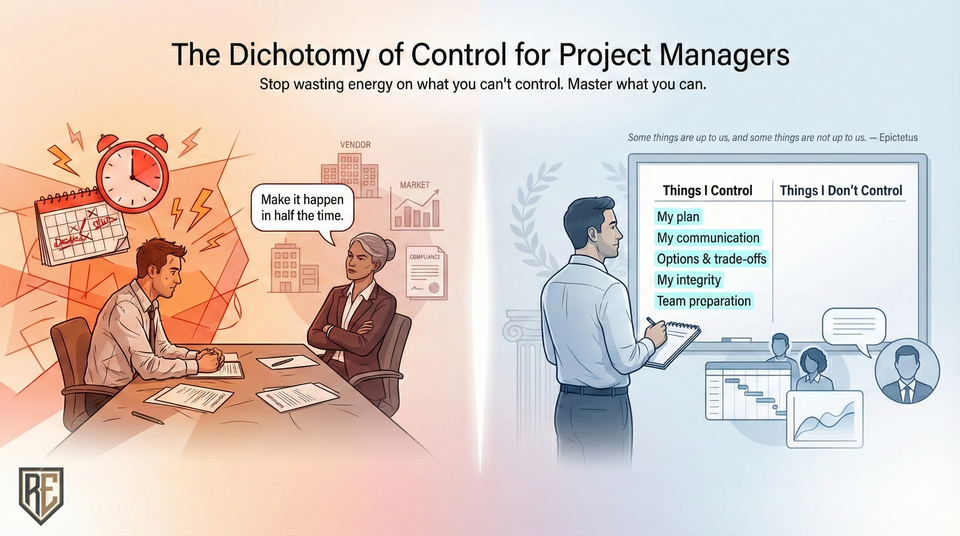
How to Stop Wasting Energy on What You Can't Control—and Master What You Can
The Crisis You Can't Control
It's 3 pm on a Tuesday. You're sitting in a status meeting with your stakeholders when the executive sponsor leans back in his chair and says, "The timeline is too long. We need to deliver in half the time. Make it happen."
You know it's impossible. Your team is already at capacity. The vendor can't (won't?) accelerate. The regulatory compliance work is non-negotiable. But there he sits, arms crossed, waiting for your answer.
Your shoulders tense. Your stomach tightens. You feel that familiar frustration—the one that keeps you awake at night, the one that makes you check email at midnight, wondering if there's something, anything, you can do to make this work.
Here's what I want to tell you: That frustration? Most of it is wasted energy.
Not because the problem isn't real. Not because you shouldn't care about delivering. But because you're spending mental energy on something that isn't actually within your control.
I learned this lesson the hard way. As a retired Coast Guard officer and Army Infantryman who moved into project management, I spent years trying to control outcomes; 'cause that's what you do, right? I learned fast that the military doesn't really work that way either. However, you can control your preparation, your team, your response, and your integrity. The battlefield, the enemy, the weather? That's beyond your control. You adapt.
Twenty-plus years of marriage, five kids, too many training programs, and a full-time PM role have taught me the same lesson over and over again: The only thing that will save your sanity is learning the difference between what you control and what you don't.
This is the first principle of Stoicism. And it might be the most important thing you read this year.
What Epictetus Actually Said
Nearly 2,000 years ago, a Stoic philosopher named Epictetus, who began his life as an enslaved person, made a simple observation that changed how we should think about our lives:
"Some things are up to us, and some things are not up to us." — Epictetus
That's it. That's the whole dichotomy of control, distilled to one sentence.
What is up to you?
- Your effort
- Your intentions
- Your values
- Your response to events
- Your standards of work
- How you treat people
- What you decide to believe about a situation
- The actions you take right now
What is NOT up to you?
- The outcome of your effort
- Other people's moods or decisions
- Market conditions
- Vendor performance
- Stakeholder expectations
- The economy
- Whether someone appreciates your work
- Your health (to some degree—you can control habits, not disease)
- How the executive sponsor reacts to bad news
Here's the stunning part: most of us spend a vast majority of our stress energy worrying about the things in that second list.
We lie awake at night playing out scenarios we can't control. We obsess over whether the executive will approve the budget. We panic about whether the vendor will deliver on time. We fret about whether the client will be happy. We ruminate about whether the project will succeed.
And while we're ruminating, we're not actually doing anything about it.
Why Project Managers Are Especially Vulnerable to This
Project managers have this unique curse: we're responsible for outcomes we only partially control.
You're responsible for hitting the deadline. But you don't control whether people show up to meetings on time. You're responsible for the budget. But you don't control inflation or vendor price increases. You're responsible for stakeholder satisfaction. But you can't control whether they change their minds about what they want.
So we try to micromanage. We send more emails. We schedule more meetings (and more meetings...). We create more detailed plans. We track more metrics. We buffer timelines with more padding. We work longer hours.
In the end, all that effort spent controlling things we can't control is energy we're NOT spending on the things we actually can control: our clarity, our communication, our team's morale, our own decision-making, and our integrity.
I've seen this pattern over and over again, especially among people new to being PMs, crisis responders, or search-and-rescue planners. Those who were most stressed weren't the ones facing the toughest projects (or response, as it were). They were the ones trying to control the uncontrollable. They were fighting against the vendor. Resenting the executive. Blaming the team. Frustrated with the bureaucracy. Cursing the weather!
The calmer ones? They had figured out what was actually within their power. And they focused there.
The Control Audit: Your Most Powerful Tool
Here's a tool from my Stoic Project Management Journal that I want to introduce to you right now. It's simple. It's free. And it changes everything once you start using it.
It's called the Control Audit.
Here's how it works:
- Step 1: Look at your current project frustrations.
- Pick something that's been bothering you. A delayed vendor. A difficult stakeholder. A shifting deadline. Unclear requirements. An impossible scope. Whatever it is.
- Write it at the top of a piece of paper.
- Step 2: Divide the paper in half.
- On the left side, write: "Things I Control"
- On the right side, write: "Things I Don't Control"
- Step 3: Be honest.
- Now, for that frustration, list out the specific elements.
- For example, let's say your frustration is: "The vendor keeps missing deadlines."
| Things you control | Things you don’t control |
|---|---|
| How you communicate with the vendor | Whether the vendor prioritizes your project |
| Your backup plan if they don’t deliver | Their team’s capacity |
| When you escalate the issue to leadership | Whether they hired better people this quarter |
| Whether you find an alternative vendor NOW (not when they fail) | Equipment failures in their facility |
| What you document (so you can have a hard conversation if needed) | Whether they respect your deadline |
| Your response and tone in your next conversation with them | How fast they actually work |
| When and how you communicate new timelines to stakeholders | |
| Whether you buffer vendor delays into your schedule |
Now here's the insight: How much mental energy are you spending on that right-side list?
Because that's wasted. That's the stuff keeping you awake at night.
The Real Shift: From Victim to Agent
Here's what happens when you do this audit-ish exercise:
You realize that you've been waiting for the vendor to change. You've been hoping they'd suddenly respect your timeline. You've been frustrated that they won't cooperate.
But your focus has been on them. On their behavior. On the uncontrollable.
The moment you move your focus to your side of the list, your actions, your standards, your decisions, something shifts. You're no longer a victim of the vendor's poor performance. You become an agent. You're the one making decisions.
Maybe you decide to find a second vendor source. Maybe you should escalate earlier. Maybe you build a buffer. Maybe you have a harder conversation sooner. Maybe you can change the contract terms. Maybe you accept that this vendor isn't right and make a change.
It matters not, because in the end, you are making a decision. You're acting. You're in control of what's actually within your power.
And the stress drops. Not because the problem went away, but because you're no longer spending energy on the uncontrollable part. You're fully present for the part where you actually have agency.
Applying the Control Audit to Your Status Meeting
Let's go back to that impossible timeline your executive just handed you.
You leave the meeting feeling like the weight of the world is on your shoulders. The deadline is impossible. You can't control the executive's expectations. You can't make people work faster. You can't accelerate regulatory work. You can't change the laws of physics.
So instead of sitting in that despair, pull out your notebook. Run a Control Audit.
Things you control:
- How and when you communicate the realistic timeline back to the executive (do it today, not tomorrow)
- What analysis do you present (data-backed, not emotional)
- What options do you offer (faster timeline + cost, or slower timeline + budget, or reduced scope + timeline—give them choices within reality)
- How you frame the conversation (problem-solver, not victim)
- Whether you've done the work to know which elements are truly fixed and which have flexibility
- Whether you get your team's input before responding (show that you've thought this through)
- What you commit to (make sure it's something you can actually control and deliver on)
Things you don't control:
- Whether the executive accepts your realistic timeline
- Whether they get frustrated
- Whether they blame you for the "delay"
- Whether they fire you
- Whether the company's strategy changes, and they cancel the project anyway
- Whether the market shifts and the whole thing becomes irrelevant
Now you can plan your response. You can prepare your data. You can align with your team. You can have a professional, grounded conversation.
You're not trying to control the executive's response. You're controlling your response. Your professionalism. Your clarity. Your integrity.
And whatever they decide, you can live with it.
The Real Power of This Framework: It Brings Peace
Marcus Aurelius, the Roman Emperor who lived 1,800+ years after Epictetus, spent his entire reign running an empire while keeping a journal about how little he actually controlled.
"You have power over your mind—not outside events. Realize this, and you will find strength." — Marcus Aurelius
An emperor. Running one of the most powerful empires the world has ever known. And his insight? The only real power is over his own mind.
That's the promise of the Dichotomy of Control.
It's not that you don't care about outcomes. You do. You should. We all should. It's about stopping the suffering over outcomes you can't control, and starting to act on the outcomes you can influence.
It's not that you become passive. You become focused.
I manage five kids (well, I help my wife do so), I'm active in an MPA program, and complex projects at one of the world's largest aerospace companies. If I tried to control all of that directly, I'd be insane by Friday.
But when I focus on what's actually mine to control, that is, my effort, my clarity, my presence, my integrity, and my response to chaos, everything gets easier. My stress drops. My decisions get better. My team trusts me more because they can see I'm grounded, not reactive.
That's the real power.
Your Assignment This Week
I want you to try this.
This week, before your next status meeting or project team meeting:
- Grab a piece of paper
- Divide it in half
- Write down what you're worried about on one side
- On the left, list what you control about that situation
- On the right, list what you don't control
- Take 2 minutes and look at that list
Notice how much of your stress energy is going toward that right-side list.
Then, in the meeting, notice where your focus naturally goes. Do you find yourself getting frustrated about things you can't control? Or are you staying grounded in what you can actually influence?
What's Next
Next week, I'm going to share a tool called the Pre-Mortem, a technique Seneca used to anticipate project failure before it happens. It's one of the most powerful risk management exercises I know. You'll be able to run it with your team in 30 minutes, and I promise you'll surface risks you never would have thought of otherwise.
But for now, start with this. Start with the Dichotomy of Control.
Get clarity on what's actually yours. Then do your best with it. Release the rest.
That's not a weakness. That's the strongest kind of leadership there is.
A Note on Living With Chaos
I want to acknowledge something outright; knowing the Dichotomy of Control doesn't make chaos stop. Your projects will still have delays. Your executives will still change their minds. Your vendors will still disappoint you. Your team will still struggle sometimes.
This isn't about eliminating difficulty. It's about responding to difficulty with clarity instead of reactivity. It's about stopping the internal war where you're fighting against reality, and instead asking: Given that this is what's happening, what's my best move?
The shift from victim to agent is everything.
Comment Below
Here's what I want to know:
What's one thing you've been stressing about that you realized—just now, reading this—is outside your control?
And what's one thing on your control list that you've been neglecting?
Comment below. I read and respond to every single comment in the first 48 hours. Let's build this community together. You're not alone in this.
Next week: The Pre-Mortem. Schedule a 30-minute session with your team, and we'll surface the risks that keep you awake at night—before they become disasters.
See you on Wednesday.
Ryan Erickson
PMP, veteran, father, perpetual student of Stoic leadership
Helping project managers lead with wisdom, courage, justice, and temperance.
P.S. If this resonated with you, please share it with a PM who needs to hear it. Sometimes we all need permission to stop trying to control the uncontrollable.


Member discussion