The Little Judge
A guilt-eating rabbit has always known good from evil, until a strange boy named Eli traps it in a house of hollowed-out adults. Inside his closet lies a collection of judged souls, and the rabbit must face whether its hunger for certainty was ever justice at all.

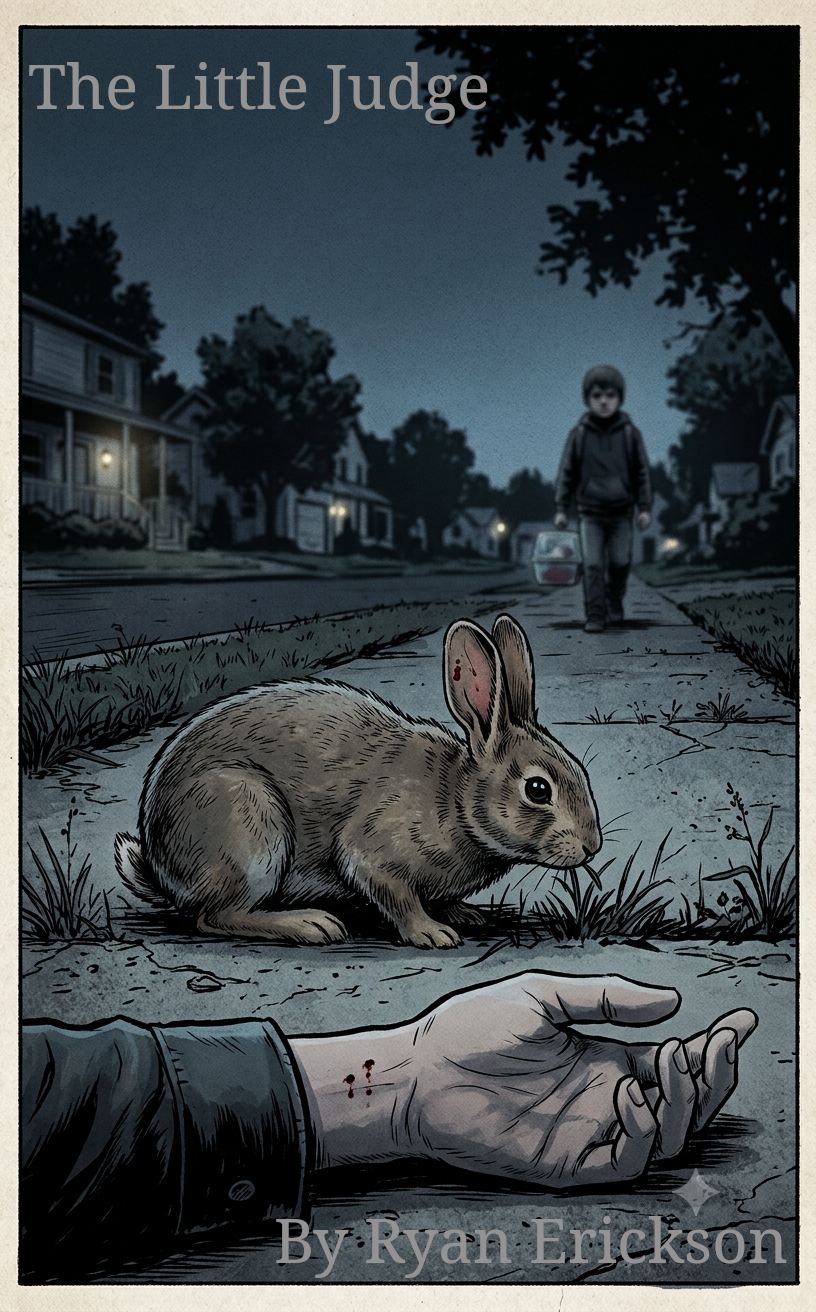
Chapter One - The Guilty Man
The rabbit knew the man was guilty before it saw him.
It had known from beneath the low branches of the juniper, where the dry dirt held the heat of the day and the shade was deep enough to hide in. It knew from the scent that came down the slope ahead of him.
Not sweat. Not exactly.
Sweat was simple. Every living thing smelled of it when it was afraid, or hot, or tired. The rabbit knew sweat. Sweat meant nothing.
This was something under it. Something sour and old. A smell that lived in the man’s skin, in the wet crease behind his knees, in the collar of his shirt. It clung to him even as the evening wind moved across the field and carried other smells with it.
Grass. Dust. Rabbits. Coyotes, far away.
The man’s smell stayed.
The rabbit sat very still.
Its front paws rested close together beneath its chest. Its ears stood tall and forward. To anyone looking at it from the dirt road above, it would have been a cottontail. Small. Gray-brown. Harmless.
Its eye was dark and round.
It watched the man come down the hill.
He wore work boots. They were too clean. His jeans had mud at one knee and a dark stain near the hem. He carried something in his right hand, swinging it carelessly as he walked.
The rabbit watched the object move.
A leash.
There was no dog at the end of it.
The man stopped near a rusted gate that separated the open field from an old irrigation ditch. He looked over his shoulder, once, then again. The road was empty. There were no houses nearby, only a few dark shapes a long way off, past the field and the trees.
He put one hand on the gate and sighed.
“Come on,” he said.
His voice was not loud.
The rabbit stayed where it was.
The man pulled the leash once.
There was a sound from behind the gate. A small sound. Nails on dry ground, maybe. Something resisting.
“Don’t make this harder than it needs to be.”
The rabbit’s nose moved.
The guilty thing inside the man shifted.
It did not always smell the same. Sometimes it was burned meat. Sometimes copper. Sometimes the cold black smell of deep water where nothing lived. This man smelled like an old closet where something dead had been left too long.
The rabbit waited.
A little dog came out from behind the gate.
It was white, except where the dirt had made it gray along its legs and belly. It was small enough that the leash pulled it forward with little effort. One of its ears folded over near the tip. Its tail was down.
The dog looked toward the field.
Then it saw the rabbit.
For a moment, the rabbit and the dog looked at one another.
The dog did not bark.
The rabbit could smell fear on it. But there was something else there too. Confusion. The animal did not understand why it had been brought out here. It did not understand the man’s voice or the hard pull on its neck. It did not understand why there was nobody else.
The rabbit understood.
It had seen this before.
The man led the dog toward the ditch.
The rabbit moved.
It did not run at first. Its small body slipped through the brush and along the dirt in quick, careful hops. The man was looking down at the dog. He did not see it.
The rabbit came within ten feet.
The man stopped.
“Just stay still,” he said.
The dog pulled back.
The man swore and jerked the leash harder.
That was enough.
The rabbit opened its mouth.
At first, nothing changed.
Then the pink line between its teeth widened.
Its lower jaw came down farther than it should have. The bones beneath its fur shifted with a sound like dry branches breaking. Its mouth opened, not outward exactly, but deeper. The shape of its head remained small, but the dark space beneath its teeth became larger than its body could contain.
The man heard the sound.
He turned.
The leash slipped from his hand.
“What the—”
The rabbit’s tongue came out.
It was long, thin, and black at the center. It moved like a whip. It crossed the space between them before the man could take a full step backward.
The tip struck him beneath the jaw.
The man made a choking sound.
The tongue wrapped once around his throat.
Then the rabbit pulled.
The man fell forward, hands clawing at the ground. His boots kicked dirt into the air. He tried to scream, but the tongue had gone into his mouth now, sliding between his teeth and down into the part of him where the rabbit could taste the truth.
The rabbit tasted the locked bathroom door.
It tasted the child crying on the other side.
It tasted the man’s hand against the wall, holding the door shut.
It tasted the little dog’s previous owner, an older woman with a shaking hand and a hospital bracelet, begging him to take care of it.
It tasted all the things the man had done when nobody was watching.
The rabbit closed its eyes.
There.
There it was.
The weight.
The guilt inside the man was black and heavy and familiar. It belonged to him. It was not an accident. It was not a mistake made once and regretted afterward. It was something he carried because he wanted to carry it.
The rabbit pulled again.
The man’s body came closer.
His face dragged through the dirt. His hands left long marks in the dry soil. He made a wet, desperate sound through the tongue in his mouth.
The dog ran.
It did not look back.
The man reached the rabbit.
His fingers caught in the fur along its back, and for a second he held on. The rabbit felt his nails scratch its skin. The man was strong. Stronger than he looked.
It did not matter.
The rabbit opened wider.
The field around it went quiet.
The man’s hand disappeared first.
Then his arm.
The rabbit swallowed.
Its mouth stretched around the man’s shoulder and chest. The man’s eyes were open. His face had gone pale beneath the dirt. He looked at the rabbit, really looked at it, as if he had finally understood what had found him.
The rabbit saw no regret there.
Only fear.
That was common.
The rabbit swallowed again.
The man’s body folded inward, impossibly, as it passed between the rabbit’s teeth. His boots kicked once above the rabbit’s head. Then they were gone too.
The rabbit’s jaw closed.
For a few seconds, it sat in the dirt.
Its sides moved in and out.
Nothing about it looked different now. It was small again. A rabbit beneath the juniper trees, in the last pale light of evening.
Except for the blood on the grass.
The rabbit licked its mouth.
The blood was gone.
The man was gone.
In the place where he had stood, the dirt was disturbed. The leash lay coiled near the gate. Nothing else remained.
The rabbit sat for a long time.
It felt full.
Not with flesh. Flesh was nothing. Flesh was only what wrapped around a person while they moved through the world. The rabbit had eaten worse things than flesh.
It had eaten what the man had made of himself.
That was what mattered.
The rabbit turned its head and listened.
The dog had gone toward the road. Its paws made faint sounds in the dirt, then no sounds at all. A truck passed somewhere beyond the trees. A bird called once and stopped.
The rabbit knew it should leave.
The dog had seen it, though dogs did not speak in ways that mattered. The man had not been expected back by anyone who would look for him right away. He had made sure of that. Guilty people often believed they were careful.
Still, the rabbit had lived long enough to know that fields changed. Roads came. Houses appeared. Humans built lights where there should have been darkness, and they asked questions when things disappeared.
It stepped out from the shade.
Its paws touched the dirt.
The evening was cooler now. The desert field held a little purple color in the distance. There was a smell of water from the ditch. The rabbit began moving toward the trees, where it could disappear and sleep beneath roots until the hunger came again.
It was halfway across the open ground when it heard the voice.
“Oh.”
The rabbit stopped.
The voice was soft.
A child’s voice.
“Oh, there you are.”
The rabbit turned slowly.
A child stood near the gate.
The child was small. Maybe eight. Maybe nine. It wore white sneakers, dark blue shorts, and a red shirt with a picture of a dinosaur on the front. Its hair was black and cut unevenly near the ears, as if someone had tried to do it at home and given up.
The child held something in one hand.
A plastic pet carrier.
The rabbit knew what it was. It had seen them before. Humans used them to carry cats, lizards, rabbits, birds. Small things that could be owned.
The child looked at the rabbit.
The rabbit looked back.
Behind the child, on the dirt road, stood a woman.
She had one hand over her mouth.
The other hand held the leash.
The dog was beside her, pressed against her legs. It had stopped shaking, but it would not look at the rabbit. Its eyes were fixed on the empty place in the field.
The woman said nothing.
The child took one step forward.
The rabbit smelled the woman first.
Fear. Sharp and hot.
Then confusion.
Then something wrong.
The rabbit’s ears moved.
It looked past the child again.
The woman stood perfectly still. Her clothes were neat. She wore a gray sweater despite the heat. Her hair was tied back in a simple ponytail. She might have been the child’s mother.
But she did not smell like a mother.
The rabbit had known mothers. They carried many scents. Worry. Exhaustion. Milk, sometimes. Anger, sometimes. Love, often enough. Love had a smell. It was warm, complicated, and painful in a way the rabbit did not understand.
The woman smelled empty.
Not innocent.
Empty.
The rabbit looked at the child.
The child smiled.
“I knew you would be here,” it said.
The rabbit did not move.
The child took another step closer.
The woman finally spoke.
“Eli,” she said.
The child stopped.
Its smile did not go away.
“Yes, Mara?”
The woman stared at the back of the child’s head. Her face was pale.
“We should go home.”
The child tilted its head.
“But I found him.”
“We should go home.”
The words sounded practiced. Flat. Like someone reading from a page.
The child looked back at her.
The woman flinched.
Only a little.
The rabbit saw it.
The child’s smile became smaller.
“Didn’t you say I could have a pet?”
“Yes.”
“You did say that.”
“Yes, Eli.”
“Then I should be allowed to keep him.”
The woman’s eyes moved toward the rabbit. She looked at it for the first time.
The rabbit watched her face.
She was afraid of it. That was clear. But not in the way the dog had been afraid. Not in the way the man had been afraid, in the seconds before the rabbit swallowed him.
She was afraid of the child.
The rabbit stayed still.
Its tongue pressed against the back of its teeth.
It could taste the air between them.
The woman had done bad things. Everyone had, in one way or another. Humans lied. They hurt people. They failed each other. The rabbit had learned that long ago.
But the woman did not carry the weight.
There was no black thing inside her.
No guilt.
No innocence either.
The rabbit’s nose moved quickly.
It did not understand.
The child crouched down.
It set the plastic carrier on the dirt and opened the small metal door.
The rabbit watched the door swing open.
Inside was a folded towel. A small bowl. A few pieces of carrot.
The child had prepared.
“I won’t hurt you,” it said.
The rabbit almost moved then.
Not because it believed the child.
Because it was angry.
The child’s scent was wrong.
It did not smell empty, like the woman. It did not smell guilty, like the man. It did not smell clean, either.
It had no smell the rabbit knew.
The rabbit’s tongue slipped out between its teeth.
The child saw it.
Its eyes widened.
Then it laughed.
Not loudly.
Not cruelly.
That would have been easier.
It laughed with the simple surprise of a child who had just seen an animal do something interesting.
“Oh,” it said. “You are not a rabbit.”
The rabbit froze.
The child leaned closer.
Its face was pale in the fading light. Its eyes were dark. Not black. Just dark enough that the rabbit could not see where the pupils ended.
“What are you?” the child asked.
The rabbit opened its mouth.
The bones in its jaw began to shift.
Behind the child, the woman made a small sound.
“Eli—”
The child put one hand up without looking back.
The woman stopped speaking.
The rabbit’s tongue came out farther.
It moved once through the air.
The child did not run.
The child held out its hand.
Its palm was small. Clean. A faint line of dirt crossed one finger. There was a thin white scar at the base of its thumb.
“Go ahead,” it said.
The rabbit’s tongue struck the child’s wrist.
It expected warmth.
It expected fear.
It expected something.
Instead, it found a door.
Not a real door. Not wood or metal. Something else. A place where the child should have been, but was not. The rabbit’s tongue pushed against it, and for the first time in longer than it could remember, the rabbit felt something push back.
The field disappeared.
Not completely. It was still there, somewhere beneath everything else. The dirt. The gate. The dead man’s disturbed patch of ground.
But the rabbit also saw darkness.
Not blackness. Blackness was still a color. This was a place before color. Before light. Before hunger had a name and before fear had a body to live inside.
Something moved behind the door.
The rabbit pulled its tongue back.
It stumbled.
Its small body rolled sideways in the dirt.
The child watched it.
For the first time, the smile left its face.
“Did you see it?” the child asked.
The rabbit righted itself.
Its heart beat too fast.
The child looked almost worried.
“Was it my mother?” it asked. “Sometimes they can see her.”
The woman behind it made no sound.
The rabbit stared at the child.
It had judged kings and murderers. It had watched men cry and beg. It had hidden beneath beds and in barns and in the walls of houses where people did terrible things to one another.
It had always known.
The guilty smelled guilty.
The good smelled good.
The others were only confused, or frightened, or weak.
This child was none of those things.
The rabbit turned to run.
The child moved faster.
One second it was crouched behind the carrier. The next it had both hands around the rabbit’s body, holding it gently beneath the chest and hind legs.
The rabbit kicked.
Its claws scraped the child’s wrist.
The child did not let go.
“You can’t go yet,” it said.
The rabbit opened its mouth.
The child looked directly into it.
Then, very carefully, the child reached one finger forward and touched the rabbit beneath the chin.
The rabbit’s mouth closed.
Not because it wanted to.
It tried again.
Nothing happened.
Its jaw would not open.
The child stood.
The woman came closer, carrying the pet carrier.
The rabbit looked at her.
Her face had gone still again. Her eyes were wet. She looked past the rabbit and toward the field, where the guilty man had disappeared.
“Mara,” the child said.
“Yes, Eli?”
“Do you think he likes carrots?”
The woman looked at the rabbit.
For a second, something moved behind her eyes.
A thought.
A plea.
Then it was gone.
“Yes,” she said. “I think rabbits like carrots.”
The child smiled again.
“Good.”
It lowered the rabbit into the carrier.
The metal door closed.
The sound was small.
A little click.
The rabbit turned in the cramped space. The towel smelled new. The carrot pieces were cold. The plastic walls blurred the field outside, but it could still see the child’s face above it.
The child picked up the carrier by its handle.
The rabbit swung gently at the child’s side as it began walking toward the road.
Behind them, the woman followed.
Not his mother, the rabbit thought.
Not his mother.
The thought came fast, small, and sharp.
Then another came after it.
Not his father, either.
The rabbit pressed itself against the side of the carrier and looked through the plastic.
There were no parents.
Only slaves.
And whatever the child was, it was taking the rabbit home.
Chapter Two - Clover
The carrier sat on the floor of the back seat.
The rabbit had stopped trying to get out.
It had tried at first.
It pushed against the metal door with its front paws. It threw its body against the plastic side. It dug at the towel until the thin fibers caught beneath its claws. The carrier moved a little each time, scraping against the black seat beneath it.
The child watched.
Not the way humans usually watched animals.
Humans watched because they thought an animal might do something. Bite. Run. Make a mess. They watched with impatience or worry or affection.
The child watched like it was waiting for an answer.
“You can stop,” it said.
The rabbit did not stop.
Its mouth would not open.
That was the worst part.
It could feel the shape of its jaw. It could feel the hidden joints beneath its fur. It could feel the place inside its throat where the tongue waited, coiled and ready. Everything was there.
But nothing moved.
The child had touched beneath its chin and closed something.
The rabbit pushed harder against the door.
The car turned.
The carrier slid an inch across the seat before the woman reached back and placed one hand against it.
“Sorry,” she said.
The child looked over from the other side of the back seat.
“It’s okay, Mara.”
The woman’s hand stayed on the carrier.
The rabbit could see her through the scratched plastic. She was facing forward, but her fingers had tightened against the side of the carrier. Her knuckles were white.
“You should use his name,” the child said.
The woman did not turn around.
“What name?”
“For the rabbit.”
The rabbit stopped moving.
The child had chosen a name already.
The woman glanced toward the rearview mirror. Her eyes met the rabbit’s for half a second. Then she looked away.
“I don’t know his name.”
“You can pick one.”
The woman’s fingers loosened.
“Clover,” she said.
The child smiled.
“Clover.”
It said the word slowly, as if testing it.
“Do you like that?”
The rabbit stared at it.
The child waited.
The rabbit stilled itself.
“That means yes,” the child said.
The woman closed her eyes.
The car kept moving.
Outside, the field was gone. The road passed through low desert scrub, then between long walls of tan block and rows of houses with gravel yards. The sun had dropped below the horizon. Porch lights came on one at a time.
The rabbit watched the world through the carrier wall.
It had been in houses before.
It preferred the spaces between them. Fields. Storm drains. Woodpiles. Empty lots. The dark places where people did not look. Houses had too many walls. Too many doors. Humans made places to keep things out, then put locks on those places because they were afraid of what they had kept inside.
The rabbit had entered homes to hunt.
It had gone through open windows. It had slipped beneath fences. Once, long ago, it had followed the smell of a guilty man through a cellar door and into a house where every room smelled of bleach.
But it never stayed.
The child was taking it somewhere to stay.
The car slowed.
A garage door opened ahead of them.
The woman pulled into a driveway and stopped.
The house was two stories, pale gray with dark shutters. It had a wide front window and a small covered entryway. There were flowers in pots on either side of the door. A bright blue bicycle leaned against the garage wall.
It looked like a good house.
The rabbit smelled the house before the child opened the car door.
Its nose moved once.
Then again.
There were people inside.
Not guilty people.
Not good people.
Empty people.
The rabbit pressed itself into the far corner of the carrier.
The child picked it up.
“You’ll like it here,” it said.
The rabbit looked through the plastic.
The child’s face was close now.
It was wearing a red dinosaur shirt. The dinosaur had a large head and tiny arms. Its mouth was open in a friendly roar.
The rabbit did not like it.
The child carried the carrier through the garage.
The woman followed behind, slower than before. She held the dog’s leash in one hand. The little white dog walked beside her with its head down.
The dog saw the rabbit and stopped.
Its ears went back.
The child looked at it.
“You can go,” it said.
The woman did not move.
The dog did not move.
The child’s expression changed.
Not much.
The smile disappeared. Its eyes narrowed slightly.
“I said, you can go.”
The dog bolted.
It ran through the open door into the house so fast that the leash snapped tight in the woman’s hand. The woman stumbled forward, nearly dropping it. The child watched the dog vanish into the kitchen.
Then it looked at the woman.
“Mara?”
“Yes, Eli?”
“Take its leash off.”
“Yes, Eli.”
The rabbit listened to the woman’s footsteps as she went inside.
The child stood in the garage for a moment, holding the carrier at its side.
The garage was clean. Too clean.
A silver car sat in one bay. A lawn mower stood against the far wall. There were plastic storage bins stacked in neat rows, labels facing outward.
The rabbit had learned the shapes of human words the way it had learned everything else.
By watching.
Christmas. Winter Clothes. School Papers. Old Toys.
The rabbit could smell dust.
Motor oil.
Cardboard.
And beneath all of it, something sweet and rotten.
It came from behind the far wall.
The rabbit turned its head.
The child noticed.
“You can smell them, can’t you?” it asked.
The rabbit went still.
The child’s smile returned.
“I thought you could.”
It carried the carrier through the door.
The kitchen was bright. Recessed lights shone down on white counters and polished tile. A bowl of lemons sat in the center of the island. A woman stood at the stove, stirring something in a pot.
She looked up when the child came in.
Her face was warm at first.
Then it changed.
Not fear. Not exactly.
Recognition.
“Oh,” she said.
The rabbit watched her.
She wore an apron over a pale green blouse. Her hair was cut short and curled under at the sides. A gold wedding ring sat on her left hand. She looked like someone’s mother.
But there was nothing behind her eyes.
No heat.
No weight.
No scent of guilt, no scent of goodness.
The rabbit had never smelled so many people like this in one place.
“Eli,” the woman said carefully. “What did you bring home?”
The child set the carrier on the kitchen island.
“My rabbit.”
The woman looked at the carrier.
The rabbit looked back.
The woman’s face went pale.
“Where did you find it?”
“Outside.”
“Where outside?”
“In the field.”
The woman looked toward Mara, who had come in behind them. Mara was kneeling near the dog, removing the leash from its collar. The dog’s body shook hard enough that its tags clicked together.
“Did you ask your father?” the woman said.
The child did not answer right away.
It stared at her.
The woman’s mouth closed.
The rabbit saw it happen.
A memory had tried to surface. Something human. Something normal. A question a parent might ask a child after it brought a wild animal home.
The child stared until the thought went away.
Then the woman nodded to herself.
“Yes,” she said. “Of course. You may keep it.”
“Thank you, June.”
“You’re welcome, Eli.”
The child touched the top of the carrier.
“You can make him a salad.”
The woman blinked.
“A salad?”
“He likes carrots.”
The rabbit looked at the child.
It knew this was not true. It did not know whether the child knew it was not true.
The woman opened the refrigerator.
“Yes,” she said. “I can do that.”
The child picked up the carrier again.
“Come on, Clover.”
It carried the rabbit down a hallway.
The rabbit passed framed photographs on the wall.
A man and a woman standing in front of the house. The woman from the kitchen, June, was in the picture. Beside her stood a tall man with dark hair and a broad smile. His arm was around her shoulder.
In another photograph, they sat at a restaurant table. In another, they stood at the edge of the Grand Canyon. In another, they held a newborn wrapped in a blue blanket.
The rabbit turned its head as the images passed.
The child in the blanket had dark hair.
The same dark eyes.
But the face was different.
Not much.
Just enough.
The rabbit looked back as long as it could.
Then the hall turned, and the photographs disappeared.
The child climbed the stairs.
Each step made the carrier swing.
The rabbit braced itself against the plastic wall.
At the top was another hallway, darker than the one below. A night-light glowed near the baseboard. There were three closed doors and one open door at the end.
The child walked toward the open door.
Its room was neat.
That was the first thing the rabbit noticed.
The bed was made. The floor was clear. Books stood in straight lines on a low shelf. There was a desk beneath the window with colored pencils in a cup and a stack of blank paper beside it.
A small lamp shaped as the moon glowed on the bedside table.
The room smelled like clean sheets, crayons, dust, and the child.
The rabbit hated the last smell most.
The child set the carrier on the floor.
“Wait here,” it said.
The rabbit stayed still.
The child went to the closet.
It opened the door.
The rabbit saw darkness behind it.
The closet should have been small. It should have held clothes, boxes, maybe shoes. The rabbit could see a few shirts hanging from a rod near the front, but the darkness behind them went farther than the room allowed.
The child stepped in.
The closet door stayed open.
The rabbit listened.
At first, it heard nothing.
Then there was a sound from inside.
A wet clicking.
Another sound answered it.
A low scrape, like claws moving across concrete.
The rabbit’s ears went back.
The child spoke softly.
“I brought another one.”
Something moved in the darkness.
The rabbit’s body became rigid.
A shape came close to the closet opening.
It was too low to be a person. Too large to be a dog. It remained in the darkness, but the rabbit saw part of it: a long pale limb resting against the edge of a cardboard box.
Its hand had too many fingers.
The fingers bent backward.
The rabbit tried to open its mouth.
Nothing.
The child looked back toward the carrier.
“This one is different,” it said. “I think it might be a judge.”
The thing in the closet clicked again.
The child nodded as if it had been told something.
“Yes. I know.”
It stepped backward out of the closet and shut the door, softly.
The click of the latch sounded louder than it should have.
The rabbit tilted its head.
The child returned to the carrier and sat on the floor in front of it. It crossed its legs. For a while, it did nothing except look at the rabbit.
The rabbit looked at the child.
The moon lamp cast a weak yellow light over the room.
“I saw what you did,” the child said.
The rabbit’s ears moved.
“You ate that man.”
The child sounded thoughtful.
“Was he bad?”
The rabbit remained still.
The child leaned closer.
“I think he was bad. Mara was scared of him. So was the dog.”
It thought for a moment.
“Were you scared of him?”
The rabbit had not been scared.
It had been hungry.
The child reached forward and tapped one finger against the carrier wall.
The rabbit flinched back.
“Do you only eat bad things?”
The child waited.
The rabbit’s mouth remained closed.
“That seems useful,” the child said. “Most things don’t know what they are until after they do something.”
It put both hands on the carrier.
“You know right away.”
The rabbit could feel the child’s palms through the plastic.
It could feel the pressure of that other place behind them. The door. The dark before dark.
The child lowered its voice.
“Do you know what I am?”
The rabbit’s body shook once.
The child smiled.
“I don’t either.”
For the first time since the field, the rabbit felt something close to confusion.
The child did not know.
Or it wanted the rabbit to believe it did not know.
That was worse.
Footsteps sounded in the hallway.
The child stood quickly.
The bedroom door opened.
The tall man from the photographs stood there.
He wore a white button-down shirt with the sleeves rolled to his elbows and dark slacks. His hair was grayer now than it had been in the pictures, parted down the middle, swept back. He looked tired. He held a glass of water in one hand.
The rabbit smelled him.
Empty.
The man looked at the child.
“Eli,” he said. “Dinner is ready.”
The child tilted its head.
“Okay, Dad.”
The man smiled.
The rabbit watched his face.
The smile appeared slowly, as if he had to remember how to make it.
“That’s good,” he said. “Come down when you’re ready.”
He looked at the carrier.
“What’s this?”
“My rabbit.”
The man stepped into the room.
He crouched beside the carrier and looked through the plastic.
The rabbit stared back.
Something moved in the man’s eyes.
Not guilt.
Not goodness.
A trapped thing.
The rabbit saw it for only a second. A human thought pressed against the empty place inside him. The thought had no words, but the rabbit understood it anyway.
Run.
The man stood.
“That’s nice,” he said.
The trapped thought was gone.
The child smiled at him.
“His name is Clover.”
“Clover,” the man repeated.
“Yes.”
“That’s a good name.”
The child’s face brightened.
The man took a step backward.
“Dinner,” he said again.
“I’m coming.”
The man left.
The child waited until his footsteps faded down the hall. Then it looked at the rabbit.
“Dad used to have a name before he was Dad,” it said.
The rabbit’s ears moved.
“I don’t remember it.”
The child sounded almost sad.
Then it shrugged.
“Maybe it wasn’t important.”
It lifted the carrier.
“Come on. You can meet everyone.”
The rabbit struggled again.
Not hard enough to move the carrier.
Just enough to know it could still struggle.
The child carried it downstairs, past the family photographs, past the kitchen, into a dining room with a long wooden table. June was placing plates in front of the chairs. Mara stood by the wall with her hands folded together.
The dog was under the table.
It saw the rabbit and let out a low, terrified sound.
The child set the carrier on an empty chair.
June brought over a small white bowl filled with chopped carrot, lettuce, and apple slices. She placed it in front of the carrier.
“There,” she said. “For Clover.”
The rabbit did not look at it.
The tall man sat at the head of the table.
The child sat to his right.
Mara sat across from the child. June sat beside Mara.
There were five place settings.
The rabbit counted the people.
Three adults.
One child.
One place set for no one.
The rabbit caught the sweet-rotten smell faintly on the chair, the same smell from the garage.
No other children.
No parents.
Only the child at the table, surrounded by people who moved when it spoke and smiled when it expected them to smile.
The child folded its hands.
Everyone else did the same.
“June,” the child said.
“Yes, Eli?”
“You can say it.”
June looked down at her plate.
Then she spoke.
“Thank you for our home,” she said. “Thank you for our food. Thank you for letting us be useful.”
The others repeated it.
Mara’s voice was barely louder than a whisper.
The tall man spoke last.
“Thank you for letting us be useful.”
The child smiled.
Then it looked at the carrier.
“Clover?”
The rabbit stared back.
The child waited.
The rabbit did not move.
“That’s okay,” the child said. “You’ll learn.”
It picked up its fork.
The adults began to eat.
The rabbit sat inside the carrier, unable to open its mouth, unable to judge the child, and unable to forget the thought it had seen inside the tall man’s eyes.
Run.
Behind the walls of the house, something clicked softly in the dark.
Chapter Three - The House Behind the House
The rabbit did not sleep.
It had slept in worse places.
It had slept under a collapsed shed while rainwater pushed through the dirt above it. It had slept in a drainage pipe with three dead rats beside it. It had slept beneath a porch while a family argued so loudly inside that the floorboards shook.
It had slept near wolves.
It had slept near men.
It had never slept in a cage in a child’s bedroom.
The moon lamp stayed on.
The room was dark except for its yellow glow and the faint blue light coming through the window. Outside, the neighborhood had gone quiet. Cars passed every so often, tires whispering across the street. A dog barked somewhere far away. Another answered it.
The house itself made small sounds.
The air conditioner came on.
Pipes clicked behind the walls.
The tall man’s footsteps moved down the hall at one point, then stopped outside the bedroom door. He stood there for a long time.
The rabbit could hear him breathing.
The door did not open.
Eventually, the footsteps went away.
The rabbit sat in the carrier with its eyes open.
The carrots remained untouched.
The towel beneath it smelled like the store. Plastic packaging. Other animals. A little disinfectant. It had been bought recently. Maybe that day. Maybe before the child had found it.
The rabbit thought about the carrier waiting in the field.
It thought about the child saying, I knew you would be here.
The rabbit had not been expected.
It had been found.
There was a difference.
The rabbit had spent a very long time understanding the difference between things. It knew prey from predator. It knew fear from hunger. It knew guilt from regret.
It knew good from bad.
That was what it did.
It did not always understand human reasons. Humans lied to themselves too much for that. They said things were accidents. They said they were sorry. They said they had no choice.
But beneath the words, there was always the truth.
The rabbit could smell it.
It had never been wrong.
Not until the field.
Not until the child.
The rabbit turned toward the closet.
The door was closed now.
The room beyond it should have been silent.
It was not.
A soft scraping came from the other side. Then a pause. Then something knocked once against the inside of the door.
The rabbit listened.
Nothing else happened.
It waited.
A long time passed.
Then, from behind the closet door, something whispered.
“Judge.”
The rabbit went rigid.
The voice was dry. Thin. It did not come through the door so much as through the floor, the walls, and the rabbit’s own skull.
“Judge,” it whispered again.
The rabbit’s ears pressed flat against its head.
The closet door opened.
Not all the way.
Only an inch.
The rabbit saw darkness in the gap.
The moon lamp did not reach it.
The rabbit waited for the child.
The child did not come.
The darkness behind the door moved.
A hand appeared.
It was gray and narrow, with seven fingers. The fingers curled around the edge of the door, then pulled it open another inch. The rabbit heard wood scrape against carpet.
The hand withdrew.
A face appeared low in the opening.
It was the face of a girl.
Or something that had once looked like one.
Her hair hung in wet, tangled ropes around her cheeks. Her skin was pale gray. Her eyes were too large and too black. One side of her mouth had been torn open nearly to her ear, then stitched badly with thick dark thread.
She looked at the rabbit.
The rabbit looked back.
The girl smiled.
“Judge,” she said.
The rabbit did nothing.
“Can you open your mouth?”
The rabbit tried.
Nothing happened.
The girl’s smile faded.
“Oh,” she said. “He closed you.”
The rabbit watched her.
The girl leaned farther out of the closet. Her shoulders passed the doorframe. She wore something like a hospital gown, gray with age and dark stains along the hem.
Her arms were too long.
She crawled forward on her hands.
The rabbit backed into the far corner of the carrier.
The girl stopped a few feet away.
She turned her head as if listening to something inside the walls.
“He’s asleep,” she whispered. “Or pretending.”
The rabbit stared at her.
The girl looked toward the bedroom door.
“He does that sometimes. Sleeps. Pretends. Makes us think he is gone.”
Her eyes returned to the rabbit.
“Then he sees what we do.”
The rabbit did not understand the words, but it understood fear.
The girl smelled of fear.
It was old fear. Deep fear. It had soaked into her like rain into wood. Beneath it, though, was something else.
Guilt.
The rabbit’s body tensed.
The smell was faint, but there.
The girl saw it happen.
“Oh,” she said quietly. “You can smell it.”
The rabbit’s nose moved.
The black weight inside her was small. Not like the man in the field. Not like a murderer, or someone who hurt people because they enjoyed the hurt. It was different.
It smelled like a door left open.
Like a child who had looked somewhere she had been told not to look.
The girl crawled closer.
“You know what I did,” she said.
The rabbit watched her.
“I opened it.”
The closet behind her made a wet, shifting sound.
The girl looked back.
“I didn’t know,” she whispered. “I didn’t know what was inside.”
The rabbit’s eyes stayed on her.
“He was little then. Smaller than me. He asked me to open the door, and I did.”
Her fingers pressed into the carpet.
“I thought he was trapped.”
The rabbit could smell the memory on her.
A different house. A different room. A door in the floor beneath a rug. A little boy crying in the dark. A hand reaching up through the crack.
The girl had opened the door.
Something had come through.
The rabbit did not know what had happened after that.
It did not need to.
The guilt was there.
The girl looked at the carrier again.
“Can you judge me?” she asked.
The rabbit went still.
She crawled close enough that her face nearly touched the plastic wall.
“Please.”
The rabbit’s mouth stayed closed.
The girl’s black eyes filled with something wet.
“You can,” she said. “I know you can. I saw you in the field.”
The rabbit flinched.
The girl smiled again, but it was not a happy smile.
“He sees through the windows sometimes.”
The rabbit looked toward the bedroom window.
The glass reflected the room back at it. The bed. The books. The moon lamp. The carrier.
No one stood outside.
The girl reached one long finger toward the carrier door.
The rabbit watched the finger move.
She did not touch it.
“He likes to keep things that think they know what they are,” she said. “That’s why he brought you home.”
The rabbit’s ears moved.
The girl looked at the closet.
Then back to the rabbit.
“You should go.”
The rabbit pressed against the plastic.
The girl gave a small laugh.
“Right. You can’t.”
A sound came from the hallway.
Footsteps.
The girl’s head snapped toward the bedroom door.
The closet door behind her opened wider.
Something inside made a clicking noise.
The girl crawled backward fast. Her hands and knees moved in sharp, awkward motions. She disappeared into the darkness.
The closet door swung shut.
By the time the bedroom door opened, the room was still.
Eli stood in the doorway.
He wore blue pajamas with little yellow stars on them. His hair was wet and pushed back from his forehead. He held a glass of water in one hand.
The rabbit watched him.
Eli looked at the carrier.
“Did you have a visitor?”
The rabbit stared.
Eli stepped into the room.
The moon lamp brightened slightly as he came closer. The rabbit saw the light on his face. He looked tired now. Not sleepy. Tired in some other way.
He set the glass on the desk.
Then he crouched in front of the carrier.
“You don’t have to be afraid of her,” he said.
The rabbit looked at the closet.
Eli followed its eyes.
“She’s mostly harmless.”
He thought about that.
“Not to herself.”
The rabbit turned back to him.
Eli rested his chin on his knees.
“She was one of the first,” he said. “Before I knew how to make them stay.”
The rabbit’s nose moved.
Eli seemed to notice.
“You can smell what people did, right?”
The rabbit remained still.
“I think that makes you special.”
He reached out and touched the top of the carrier with one finger.
The rabbit’s body tightened.
“But sometimes people do bad things because they are bad,” Eli continued. “And sometimes they do bad things because they’re scared.”
The child looked at the closet.
“And sometimes they do bad things because someone asks them to. Or demands it of them.”
The rabbit did not understand why he was telling it this.
Eli looked back.
“Do you know the difference?”
The rabbit did.
The question was simple.
The man in the field had known what he was doing. The girl in the closet had not. The guilt in her was real, but it was not the same.
The rabbit had never eaten someone just because they were afraid.
It had never eaten someone who had made one mistake and spent the rest of their life carrying it.
Eli smiled a little.
“I don’t think you do.”
The rabbit’s eyes narrowed.
Eli stood.
“You’ll learn.”
He walked to the door and turned off the moon lamp.
The room went dark.
The rabbit heard the bedroom door close.
Then the lock clicked.
The rabbit waited.
The house stayed quiet for a long time.
Then the closet door opened again.
This time, the girl did not come out.
A small metal object slid across the carpet.
It stopped against the carrier.
The rabbit looked down.
A key.
The girl whispered from inside the closet.
“Don’t make noise.”
The rabbit stared at the key.
It was a small key, old and dark with rust. It had a circle at one end and a narrow tooth at the other. It smelled like the closet. Like wet dirt. Like old blood.
The rabbit moved closer.
The carrier door had a metal latch. The keyhole was small, but there.
The rabbit could not use its paws the way a human could. Its claws were made for dirt, not locks. It nudged the key with its nose.
The key turned slightly.
The carrier door rattled.
The rabbit froze.
Nothing happened.
From the closet, the girl whispered, “Again.”
The rabbit pushed the key harder.
It slid beneath the latch.
The rabbit pressed its nose against the circle end and twisted.
Once.
Twice.
The lock gave a small click.
The carrier door opened half an inch.
The rabbit leaned a bit.
The girl did not speak.
The rabbit pushed the door farther.
It opened slowly.
The metal made a quiet scraping sound against the plastic side.
The rabbit stepped out.
Its paws touched carpet.
For the first time since the field, it was not inside something.
It stood still.
The room was dark. The only light came through the window now. Enough to see the outlines of the bed and desk. Enough to see the closet door open a few inches.
The rabbit looked toward it.
The girl’s face appeared in the gap.
“Go,” she whispered.
The rabbit did not.
Its mouth was still closed.
Its power was still gone.
It could run. It could hide. It could bite if it had to, but it was not made for biting, not like other rabbits. Its teeth were small.
The girl watched it.
“What?” she whispered.
The rabbit moved toward the closet.
The girl’s eyes widened.
“No.”
The rabbit kept going.
“No,” she said again, louder this time. “Don’t come in here.”
The rabbit stopped near the door.
The darkness inside smelled wrong.
It smelled like the child. It smelled like old rain, burned hair, wet stone, and something sweet enough to make the rabbit’s nose twitch.
But it also smelled like the girl.
And others.
The rabbit heard breathing.
Not one breath.
Many.
The girl pushed the door open a little wider.
“You don’t understand.”
The rabbit looked up at her.
She shook her head.
“You think this is a room.”
The rabbit waited.
“It isn’t.”
A sound came from deeper in the closet.
A low voice.
Not words.
Something speaking in a language that had no sound the rabbit recognized. The floor beneath its paws vibrated.
The girl looked over her shoulder.
“They’re awake,” she said.
The rabbit stepped into the closet.
The girl grabbed for it.
Her long hand closed around empty air.
The rabbit moved past her legs and into the dark.
At first, it was just a closet.
The rabbit could see shirts hanging from a rod above. Shoes lined up against the wall. A cardboard box marked Winter Clothes. The smell of mothballs and dust.
Then it took another step.
The floor changed.
Carpet became stone.
The air became cold.
The closet ceiling disappeared.
The rabbit stood at the edge of a long hallway.
It was not possible.
It was also there.
The hallway stretched away into darkness. Doors lined both sides. Some were wooden. Some were metal. One was made of something white and smooth, like bone. Another had no handle, only a large eye set in the center.
The eye blinked.
The rabbit froze.
At the far end of the hallway, a light flickered.
It was not electric. It looked like candlelight, but it moved beneath the surface of the wall. The stone around it pulsed slowly.
The girl crawled out of the closet behind the rabbit.
She grabbed its back gently but firmly.
“You need to go back,” she said.
The rabbit kicked once.
“Stop.”
The rabbit turned toward her.
The girl looked afraid.
Not of the hallway.
Of the rabbit.
“You don’t know what he keeps in here,” she whispered.
The rabbit stared past her into the hall.
A door somewhere far away opened.
Something screamed.
The sound lasted less than a second.
Then it stopped.
The girl’s grip tightened.
“He doesn’t hurt us,” she said. “Not exactly.”
The rabbit looked at her.
“He doesn’t have to.”
The rabbit smelled the doors.
Each one had its own scent.
One smelled of blood and rust.
One smelled of ocean water.
One smelled like the inside of a church after everyone had gone home.
One smelled guilty.
The rabbit turned toward it.
The girl saw.
“Don’t,” she said.
The rabbit moved forward.
The girl followed behind, low to the ground. She did not try to stop it again.
The guilty smell came from a small wooden door on the left side of the hall. It was painted blue, though most of the paint had peeled away. A brass knob sat near the middle. It looked like a bedroom door from an old house.
The rabbit stood in front of it.
The smell was stronger here.
Not one person.
Many.
Guilt layered over guilt. Fear. Rage. Shame. Regret.
The rabbit’s mouth remained shut.
It pressed its nose to the crack beneath the door.
Warm air drifted out.
The girl sat behind it.
“That’s the bad room,” she whispered.
The rabbit turned its head.
“The ones in there are bad.”
The rabbit looked at the door again.
The girl’s voice shook.
“I think.”
The rabbit’s ears moved.
You think?
The girl stared at the rabbit another moment, then at the floor.
“I don’t know anymore.”
Something inside the room knocked against the door.
Once.
Then again.
A man’s voice came from the other side.
“Please.”
The rabbit froze.
The voice was weak. Hoarse.
“Please, I know you’re there.”
The girl covered her mouth with one hand.
The man knocked again.
“I didn’t know,” he said. “I didn’t know what it was.”
The rabbit listened.
The scent beneath the door was heavy. It carried guilt, yes.
But it also carried the same smell the girl had carried.
A mistake.
Fear.
The rabbit did not move.
The man’s voice came again.
“Whoever you are. Please. Don’t let him take me again.”
The girl looked at the rabbit.
“See?” she whispered. “That’s why you need to leave.”
The rabbit stood in front of the door.
Something inside it shifted.
The man began crying.
From far down the hall, another door opened.
The girl’s face went pale.
“He’s awake,” she whispered.
The rabbit turned.
At the end of the hallway, beneath the pulsing light in the wall, a small figure stood in the dark.
Eli.
He wore his blue pajamas.
His bare feet rested on the stone floor.
The hallway behind him stretched into a darkness that looked larger than the house, larger than the neighborhood, larger than the field where the rabbit had first seen him.
Eli smiled.
“Clover,” he said.
One of the rabbit's ears moved.
The child began walking toward them.
“I was hoping you’d come see.”
Chapter Four - Things Without Names
Eli walked toward them.
He did not hurry.
His bare feet made soft sounds against the stone floor. The hallway seemed to change around him as he moved. The doors became clearer, then less clear. The ceiling lowered. The pulsing light beneath the walls slowed down.
The rabbit watched the child come closer.
The girl behind it did not move.
“Don’t,” she whispered.
The rabbit did not know whether she meant don’t run or don’t make him angry.
Maybe they were the same thing.
Eli stopped a few feet away.
He looked at the rabbit first. Then at the girl.
“You let him out.”
The girl pressed herself against the wall.
“I only opened the carrier.”
Eli tilted his head.
“That’s not the same thing?”
“He was scared.”
“So were you.”
The girl looked down.
The child waited.
Nothing happened.
The rabbit could smell the fear in her again. It rose off her in sharp, hot waves. The guilt beneath it was still there, but the rabbit understood it better now. The girl was not guilty because she had opened the first door. Not only because of that.
She was guilty because she had survived when others had not.
The rabbit had smelled that before.
Humans carried it when something terrible happened, and they had been the one left standing. They called it guilt because they had no better word for it. Sometimes it became heavy enough to poison them. Sometimes they let it convince them they deserved punishment.
The rabbit had always known the difference.
Or it had believed it did.
Eli looked down at the girl.
“Are you trying to leave?”
“No.”
The answer came too fast.
Eli smiled.
“That’s good.”
He crouched and held one hand out toward the rabbit.
The rabbit backed away.
The child’s hand stayed where it was.
“You don’t have to be scared,” Eli said.
The rabbit looked at the hand.
It remembered the field.
The door behind the child’s skin.
The place before darkness.
It did not move closer.
Eli lowered his hand.
“That makes sense,” he said. “You don’t know me yet.”
The rabbit’s ears stayed flat.
The child looked down the hall toward the blue door. The man inside had stopped crying. The hallway had gone quiet again, except for the wet clicking from somewhere far away.
Eli walked past the rabbit.
The girl moved away from him as he passed.
He stopped at the blue door and rested one hand against the wood.
“Do you want to see?” he asked.
The rabbit only twitched its whiskers.
Eli looked back.
“You came all this way.”
The rabbit stared at the door.
The scent beneath it had changed.
The guilt was still there, but it no longer came in one heavy mass. The rabbit could smell separate things now. Separate people. Separate lives.
A man who had stolen from his sister.
A woman who had left her child in a car while she went inside a store.
A boy who had broken another boy’s arm because everyone else had laughed.
An old man who had hit his wife only once, then spent forty years pretending it had never happened.
The rabbit’s nose moved quickly.
There were more.
A woman who had lied.
A man who had cheated.
A child who had wished someone dead.
A girl who had opened a door.
The rabbit looked at Eli.
The child watched it with dark, patient eyes.
“They’re all bad,” Eli said.
The girl made a small sound behind the rabbit.
Eli looked at her.
“Are they not?”
She said nothing.
Eli turned back to the rabbit.
“You know, don’t you?”
The rabbit did know.
Every person behind the door had done something wrong. Some things were worse than others. Some things were small. Some things were terrible.
But the rabbit smelled something else there, too.
Regret.
Not all of them had it.
Some did.
The rabbit stood in front of the blue door and remembered the man in the field. There had been no regret in him. No pain for anyone except himself. He had been afraid when the rabbit found him, but he had not been sorry.
The man behind this door had been sorry.
The woman had been sorry.
The boy had been sorry.
Some were still sorry.
Eli turned the brass knob.
The rabbit stepped forward.
The girl grabbed at its fur, but she stopped before touching it.
“Don’t,” she whispered.
The door opened.
Warm yellow light spilled into the hallway.
The room beyond was large.
It looked like a classroom.
There were desks in straight rows. A chalkboard stood at the front. Posters covered the walls: the alphabet, multiplication tables, a map of the United States. A paper sun hung from the ceiling on a piece of string.
The room smelled like pencil shavings and dust.
It also smelled like guilt.
There were people sitting at the desks.
The rabbit counted twelve.
A man with thinning gray hair sat in the first row. He wore a wrinkled dress shirt and kept his hands folded tightly on top of the desk. A woman in a nurse’s uniform sat behind him, her eyes fixed on the floor. A teenage boy with a shaved head sat near the back, tears running silently down his face.
The girl in the hallway made a choking sound.
The people in the room looked toward the door.
The man in the front row saw Eli.
His face changed.
“No,” he said.
Eli stepped inside.
The rabbit followed.
The girl remained in the hallway.
The classroom door stayed open.
The rabbit moved carefully across the tile floor. Its paws made no sound. It passed between the desks, smelling each person as it went.
They all had guilt.
They all had fear.
But the guilt was different from the man in the field.
It had edges.
It had context.
A woman had stolen money from her aging father. She had told herself it was a loan. She had promised herself she would pay it back. Then her father died before she did.
A young man had driven home drunk. He had not killed anyone, but he had put his car into a telephone pole and left his friend bleeding in the passenger seat while he ran for help. He had run because he was scared. His friend had lived. The young man still saw his face every time he closed his eyes.
An older woman had said terrible things to her daughter during their last phone call. Her daughter had died three days later in a car accident. The words stayed with the woman, repeating every day.
The rabbit stopped.
It could smell all of it.
Eli stood at the front of the room.
“They’re not nice,” the child said.
No one answered.
“They hurt people. They lied. They made choices.”
The man in the front row looked at the rabbit.
He had pale blue eyes.
“Please,” he said.
The rabbit looked at him.
“Please,” the man said again. “You don’t know what this is.”
The child frowned.
“He can understand you.”
The man’s mouth closed.
The rabbit went closer.
The man smelled of guilt, yes. But also of something else. The rabbit searched for it. It pressed its nose near the man’s shoe.
There.
A child.
The man had a child somewhere beyond this place. A young boy. The man had yelled at him. He had grabbed him too hard once. He had taken money he should not have taken. He had made choices that hurt people.
But he had also changed.
The rabbit smelled it.
The man had stopped drinking. He had apologized. He had gone to counseling. He had called his son every week even when the boy refused to answer. He had tried.
The rabbit looked up.
Eli was watching.
“Is he good?” the child asked.
The rabbit did nothing.
Eli waited.
The question hung in the room.
The man’s face tightened.
The rabbit knew the answer was not simple.
The man had been bad.
The man had done bad things.
The man was trying to be better.
The rabbit had never needed to consider whether all those things could be true at once.
Eli stepped closer.
“He hit his son.”
The man flinched.
Eli’s voice stayed calm.
“He stole money from people who trusted him. He blamed other people for his mistakes. He made his wife afraid of him.”
The rabbit smelled the truth in every word.
The child crouched beside it.
“Is that good?”
The rabbit looked at the man.
The man looked back.
His eyes filled with tears.
“No,” he said.
Eli smiled faintly.
“See?”
The rabbit moved away from the man.
It went to the woman in the nurse’s uniform.
She smelled like antiseptic, old coffee, and guilt. Her hands were trembling in her lap.
Eli followed behind.
“She took medication from work,” he said. “She told herself she needed it because she was tired. Then she started taking more.”
The woman’s jaw clenched.
“One day, a patient was in pain. Real pain. And she had already taken the medicine meant for him.”
The rabbit smelled the scene.
A hospital room. Bright lights. A man with a gray face and sweat on his forehead. The woman opening a cabinet, seeing what should have been there, and finding nothing.
The patient had not died.
But the woman had never forgiven herself.
Eli touched the edge of the desk.
“Bad?”
The rabbit looked at the woman.
She whispered, “Yes.”
The child turned to the rabbit.
“Bad?”
The rabbit stayed still.
Behind them, the girl stepped into the doorway.
“Stop it,” she said.
Eli looked over his shoulder.
“I’m teaching.”
“You’re not.”
The child’s expression went blank.
The room grew colder.
The rabbit felt it in its fur. Every person at the desks froze. The woman in the nurse’s uniform stopped breathing. The teenager at the back lowered his eyes.
The girl stood in the doorway, shaking.
“You don’t teach,” she said again. “You just make people say things.”
Eli stared at her.
For a moment, the child was gone.
Not physically.
Its body was still there. Small. Thin. Bare feet on tile. Blue pajamas with yellow stars.
But the rabbit could see the other thing behind it.
The door.
The place before darkness.
It opened wider than it had in the field.
The classroom walls pulled away.
The desks became smaller.
The people inside them became smaller.
The rabbit’s body pressed itself to the floor.
The child’s eyes were dark now. Not brown. Not black. Empty.
The girl took one step backward.
“I’m sorry,” she said.
The child looked at her.
Then the room returned.
The walls snapped back into place. The paper sun swayed from the ceiling. The desks stood in straight rows again.
Eli blinked.
The child was back.
It looked confused.
“Why are you sorry?”
The girl stared at him.
Eli’s face softened.
“I wasn’t mad.”
The rabbit did not believe it.
Eli walked toward the girl.
She pressed herself against the doorframe.
The rabbit watched the child reach up and place one small hand against the girl’s cheek.
“You don’t have to be afraid,” Eli said.
The girl began to cry.
“I am.”
The child looked genuinely sad.
“I know.”
He wiped one tear from her cheek with his thumb.
Then he turned back to the rabbit.
“Come on,” he said. “There are more.”
The rabbit did not follow at first.
It stayed beside the man’s desk.
The man had not moved.
Eli looked back.
“Clover.”
The rabbit stayed where it was.
The child’s smile disappeared.
“You don’t have to be scared of them,” he said.
The rabbit looked at the man again.
The man’s hands were still folded on the desk. His eyes were fixed on the rabbit. He did not ask for help again.
He had learned something.
The rabbit understood that, too.
In this place, asking only made it worse.
The child waited.
Then it walked down the aisle toward the far wall.
A door stood there that had not been there before.
It was small. White. Painted clean and new. A reflective gold handle sat near the middle.
Eli opened it.
Beyond it was a kitchen.
Not the kitchen upstairs.
This one was older. The counters were dark. The floor was yellowed linoleum. A refrigerator hummed in the corner. Rain tapped hard against a window over the sink.
The rabbit smelled a different house.
A different time.
A woman sat at the kitchen table.
She was young. Younger than Mara. Younger than June. Her hair was dark and pulled into a loose ponytail. She held a baby against her chest, wrapped in a blue blanket.
The rabbit stopped at the doorway.
The room smelled almost right.
The rain against the window carried no water.
The linoleum had no history under it.
The baby had no smell at all.
The woman looked up.
Her eyes moved past Eli.
Then they found the rabbit.
“Oh,” she said.
Eli smiled.
“Hi, Mom.”
The woman’s face changed.
Fear moved through her.
Not the flat fear of Mara or June. Not the old, soaked-in fear of the girl in the hallway.
This was new.
Alive.
She stood so fast the chair tipped backward.
The baby began to cry.
Eli stepped into the kitchen.
The woman backed away from him, holding the baby tightly.
“No,” she whispered.
“Mom.”
“No.”
The rabbit looked at the child.
Eli’s face remained calm.
“You said you wanted to see me.”
The woman shook her head.
“No. I said I wanted to see my son.”
The rabbit’s ears moved.
Eli blinked.
“I’m your son.”
The woman’s face twisted.
She looked down at the baby in her arms. Then back at the child standing in front of her.
“You were,” she said.
The child looked confused.
The rabbit smelled something in the room.
Guilt.
The woman had it.
Not for what she had done.
For what she had failed to do.
The rabbit moved closer.
Eli saw and smiled.
“Go ahead,” the child said. “Ask her.”
The rabbit did not have to ask.
It smelled the memory in the woman’s skin.
A house in the woods.
A storm.
A little boy crying behind a locked door.
The woman sitting at this same table, hands shaking around a cup of coffee. A man standing near the sink, telling her it was only a phase. Telling her they needed to be patient. Telling her the doctors did not understand.
Then the sounds from behind the locked door.
Not crying anymore.
Something else.
The woman had taken the key.
She had stood in the hallway.
She had put her hand on the knob.
Then she had walked away.
The rabbit looked up at her.
The woman’s eyes filled with tears.
“I didn’t know what to do,” she whispered.
Eli’s smile grew.
“You left me in there.”
“I was afraid.”
“You left me alone.”
The woman shook her head.
“No. No, I came back.”
Eli looked at the baby.
The rabbit saw the woman realize what she had done.
She held the baby tighter.
The child did not look at the baby.
Not at first.
Then it did.
The kitchen light flickered.
The rabbit felt the room change.
The woman backed into the counter.
“Don’t,” she said.
Eli took one step forward.
“You wanted a second chance.”
The woman began crying.
“I’m sorry.”
The child tilted its head.
“Are you?”
The rabbit moved between them.
It did not think.
It only moved.
Its small body crossed the floor and stopped in front of Eli’s bare feet.
The child looked down.
The rabbit stared up at him.
For a moment, neither moved.
The woman behind the rabbit made a small, broken sound.
Eli looked at the rabbit.
“Do you think she’s good?”
The rabbit did not know.
The woman had failed her child.
She had abandoned him when he needed her.
But she had been afraid.
She had come back.
She had tried to find him. The rabbit smelled years of searching. Years of grief. Years of telling herself she had failed, even before anyone else told her.
The child waited.
The rabbit stayed where it was.
Eli’s expression changed.
Not anger.
Interest.
“You don’t know.”
The rabbit’s ears rose slightly.
The child crouched.
“That’s new.”
The rabbit watched him.
“You always knew before.”
The child reached toward the rabbit’s head.
It stopped inches above its fur.
“What if she’s both?”
The rabbit’s ears moved separately.
“What if the man in the classroom is both?”
Eli’s hand hovered above it.
“What if the girl is both?”
The rabbit thought of the gray girl in the hallway.
The first door.
The mistake.
The fear.
Eli’s voice became softer.
“What if you are?”
The rabbit’s body froze.
The child smiled.
“I saw the way you ate him.”
The rabbit remembered the man in the field.
The man’s face in the dirt.
His hands reaching.
The hunger.
The certainty.
The quiet afterward.
“You liked it,” Eli said.
The rabbit wanted to open its mouth.
It could not.
“You didn’t just punish him.”
The child leaned closer.
“You liked being right.”
The rabbit’s heart beat faster.
Eli pulled his hand away.
The kitchen door opened behind them.
The girl stood there.
Her gray face was pale beneath the wet hair.
“Let them go,” she said.
Eli turned.
The woman clutched the baby tighter.
The rabbit stayed between her and the child.
The girl stepped into the kitchen.
“I said let them go.”
Eli stared at her.
“You don’t get to tell me what to do.”
“I know.”
“Then why are you doing it?”
The girl looked at the rabbit.
Then at the woman.
Then at Eli.
“Because I’m scared.”
The child’s face changed.
The rabbit saw the doorway open behind his eyes again. Just a little. The wrong dark place. The place that had no smell and no edge.
But this time, the girl did not look away.
She stayed where she was.
Eli looked at her for a long moment.
Then he smiled.
“Good.”
The kitchen disappeared.
The rabbit stood once more in the hallway behind the closet.
The woman was gone.
The baby was gone.
The classroom door was closed.
The blue door remained at the far end of the hall.
Eli stood beside the rabbit.
The girl was on the other side of him.
Neither spoke.
The hallway pulsed slowly around them.
Then the rabbit heard a sound behind it.
A soft metallic click.
It turned.
The closet door was open.
Beyond it was Eli’s bedroom.
The moon lamp glowed on the bedside table.
The carrier sat empty on the floor.
The ordinary room looked impossibly far away.
The rabbit took one step toward it.
Eli did not stop it.
It took another.
The girl watched from the hallway.
The rabbit crossed the threshold.
Carpet returned beneath its paws.
The closet door swung shut behind it.
The click of the latch echoed through the room.
The rabbit stood alone.
The house was still there. It could smell the house through the floor.
Mara slept in one room downstairs, empty and afraid.
June slept in another, dreaming nothing.
The tall man lay awake in bed, staring at the ceiling and trying to remember his own name.
The dog hid beneath the kitchen table.
And somewhere beyond the closet door, the child stood in a hallway that was not a hallway, surrounded by things it had collected because they knew what they were.
The rabbit sat beside the empty carrier.
For the first time in its long life, it did not know what it was supposed to do next.
Chapter Five - The First Wrong Thing
The rabbit sat beside the carrier until morning.
It did not go back inside.
The closet door stayed closed.
The room stayed quiet.
At some point, the moon lamp turned itself off. The blue-gray light outside the window became pale yellow. A car started in a driveway nearby. A garage door groaned open, then shut.
The house woke up.
Pipes clicked in the walls.
Water ran in the bathroom.
A door opened downstairs. The tall man walked through the hallway, his footsteps slow and uneven. He stopped beneath the rabbit’s room for a moment.
The rabbit listened.
Then the man said, very softly, “Daniel.”
The rabbit’s nose moved. For a length of breath, the man smelled almost alive.
The word sounded like something he was trying on. Like a coat from the back of a closet.
The name almost fit.
The man stood there a little longer.
“Daniel,” he said again.
This time, a floorboard creaked above him.
Downstairs, the man went quiet.
The rabbit looked toward the bedroom door.
Eli was standing on the other side.
The rabbit could smell him through the wood.
The door opened.
Eli wore different clothes now. A yellow T-shirt. Jeans. White socks. His hair had been brushed, though one piece at the back stuck up anyway.
He stood in the doorway and looked at the rabbit.
“You got out.”
The rabbit stayed beside the carrier.
Eli stepped into the room.
He closed the door behind himself.
The rabbit watched his hands.
They were empty.
“I knew you could,” he said.
The rabbit did not move.
Eli looked at the closet.
“You met the others.”
The rabbit's nose moved. The wrongness remained. The place inside him was closed now, or hidden. Either way, it was there.
“You can open your mouth again.”
The rabbit stopped.
The child tilted his head.
“I didn’t close it forever.”
The rabbit’s jaw shifted.
Slowly at first.
Then all at once.
The bones beneath its cheeks pulled apart with a soft, dry crack. Its mouth opened farther than any mouth should. The rabbit felt the tongue uncoil from deep inside its throat. It slid over its lower teeth and into the open air.
Eli smiled.
“There you are.”
The rabbit closed its mouth again.
It stood.
The child crouched near it.
“Are you hungry?”
The rabbit looked at him.
“I could have June make you something better than carrots.”
The rabbit’s eyes narrowed.
Eli thought about that.
“Not people,” he said. “Not unless they deserve it.”
The rabbit moved away from the carrier.
Eli followed it with his eyes.
“You know who deserves it.”
The rabbit stopped near the bedroom door.
The child stood.
“I want you to help me.”
The rabbit looked back.
Eli’s face was serious now.
Not sad.
Not angry.
Just serious.
“There are people outside this house,” he said, “who do bad things. Worse things than the people downstairs. Worse things than the people in the classroom.”
The rabbit knew that was true.
There were always people like that.
It could smell them from a long way off sometimes. The black weight traveled. It clung to their clothes, their cars, their houses. It followed them into stores and schools and churches. It lived beneath their words.
Eli took a step closer.
“I can find them.”
The rabbit stayed still.
“And you can decide.”
The child looked almost excited.
“You can tell me who is bad. You can tell me who should stay and who should go.”
The rabbit watched him.
Eli smiled.
“You could make things better.”
The rabbit remembered the field.
The man in the dirt.
The dog running away.
The clean certainty after.
For the first time, the memory did not feel clean.
It felt hot.
It felt like hunger.
The rabbit’s tongue moved once across its teeth.
Eli saw it.
“That’s what you want, isn’t it?” he asked.
The rabbit did not answer.
“You want to make things right.”
A knock came at the bedroom door.
Eli turned.
“Yes?”
June opened the door a few inches.
“Breakfast is ready,” she said.
Eli looked at the rabbit.
“Come on, Clover.”
The rabbit did not follow.
The child waited.
Then he walked out of the room.
The rabbit stood beside the open carrier.
It listened to the child go down the stairs.
It listened to June follow him.
For several seconds, the house was quiet.
Then the closet door clicked.
The rabbit turned.
The door opened slowly.
The gray girl crawled out.
In the daylight, she looked worse.
Her skin was the color of ash. The stitches along her face were dark and uneven. Her hospital gown hung loose around her narrow body. Her black eyes looked toward the bedroom door first, then toward the rabbit.
“You’re still here,” she said.
The rabbit watched her.
She sat back on her knees.
“He gave you your mouth back.”
The rabbit opened it a little.
The girl flinched.
It closed its mouth.
“I know,” she said. “I’m sorry.”
The rabbit looked at her.
The girl rubbed both hands against her arms.
“You need to leave before he takes you somewhere.”
The rabbit’s ears moved.
“He wants to take you outside.”
The rabbit remained still.
“He does that when he gets tired of the house.”
The girl looked toward the window.
“At first, it feels like a good thing. You get to see people again. You get to move. You think you’re helping him.”
The rabbit smelled fear on her.
What happens?
The girl’s eyes dropped.
“You become part of it.”
The rabbit waited.
“He makes you choose.”
The rabbit’s tongue slipped out.
The girl shook her head.
“No. Not just who deserves it.”
The hallway door beneath the closet waited behind her.
The rabbit could feel it.
“He finds people who have done something bad,” the girl continued. “And he finds people who have done something good. Then he finds people who did both.”
The rabbit thought of the classroom.
The man who had hurt his son and then tried to change.
The nurse.
The woman in the kitchen.
The child’s mother.
“You decide,” the girl said. “You say good or bad. You say which one they are.”
The rabbit’s ears lowered.
And then?
The girl’s face tightened.
“Then he makes it true.”
The rabbit moved a little.
The girl looked toward the closet.
“I saw it once.”
Her voice had become smaller.
“There was a man. He had done bad things. Real bad things. But he had a little girl. He was trying to stop. He was trying to be different. Eli asked someone to judge him.”
The rabbit watched her.
“The person said bad.”
The girl swallowed.
“So Eli made him bad.”
The rabbit stayed still.
“He took away everything else. The part that was sorry. The part that loved his daughter. The part that wanted to change.” She looked up. “It was easier for Eli that way.”
The room seemed colder.
The rabbit smelled the truth in her.
Not all of it. The girl had been afraid for too long. Fear twisted memories. Fear hid pieces.
But enough of it was true.
Eli did not want justice.
He wanted certainty.
The rabbit knew that feeling.
It had lived by it.
The girl crawled closer.
“He can’t make people good,” she whispered. “Not really. He only makes them quiet.”
The rabbit thought of Mara.
June.
Daniel.
Useful.
That was what June had said.
Thank you for letting us be useful.
A sound came from downstairs.
Eli laughing.
The gray girl flinched hard.
“You need to go.”
The rabbit looked at the window.
It was closed.
The house was two stories up. The ground below was covered in gravel and a strip of hard dirt beside the driveway. A rabbit could survive the fall, probably. Its body was small. It had fallen farther before.
But the yard was open.
The street was open.
The child would find it.
The girl saw where it was looking.
“That won’t work.”
The rabbit looked at her.
“He always finds what gets out.”
The rabbit moved toward the closet.
The girl put both hands up.
“No.”
The rabbit stopped.
“Not through there,” she said. “That’s where he wants you to go.”
The rabbit looked past her into the dark.
The hallway waited.
The blue door.
The classroom.
The kitchen from before.
The other doors.
The rabbit could still smell guilt from beyond them. It could smell fear. It could smell things that had been trapped long enough to forget what freedom was.
The girl’s face changed when she saw it decide.
“No,” she said again.
The rabbit stepped closer to the closet.
“You can’t save them.”
The rabbit stopped in front of her.
“He owns that place.”
The rabbit lowered its head.
The girl’s hands shook.
“He owns all of it.”
The rabbit looked at the closet.
Then it looked at the girl.
It had never been asked to save anyone.
It had only been asked to judge.
The difference sat inside it like a stone.
The girl followed its eyes.
“You want to open the doors.”
The rabbit did not move.
She began to cry.
“He’ll know.”
The rabbit stepped into the closet.
The floor became stone.
The gray girl stayed behind.
The rabbit heard her whisper from the threshold.
“You don’t know how many there are.”
The rabbit entered the hallway.
This time it was brighter.
The pulsing light in the walls had become a thin red glow. The stone beneath its paws was warm. Doors stretched away in both directions, farther than before.
The hallway was not a hallway.
It was a collection.
The rabbit understood that now.
Each door held something Eli had found. People. Creatures. Memories. Maybe entire pieces of the world. Each one waited behind a lock because the child had wanted it to wait.
The rabbit walked toward the blue door.
It could smell the classroom again.
The people inside were awake.
Fear moved beneath the crack.
The rabbit stopped.
Its tongue extended toward the brass knob.
It did not touch it.
The rabbit had no hands for locks.
It could not turn knobs.
It could not lift latches.
It could not free anyone.
The tongue touched the blue paint.
The door shuddered.
The rabbit pulled back.
Inside, someone gasped.
The rabbit stared at the door.
It touched the knob again.
This time, it pushed farther.
The tongue slid around the brass and into the narrow space where the lock met the wood.
The rabbit felt something there.
Not metal.
A word.
A rule.
A small, hard thing that said stay.
The rabbit tasted it.
The rule tasted like Eli.
The rabbit opened its mouth wider.
Its tongue lashed once against the door.
The hallway shook.
The blue door flew open.
Warm classroom light poured out.
The people inside looked toward it.
The man in the front row stood so fast that his chair fell backward.
“What happened?” he said.
The rabbit stepped aside from the doorway.
No one moved.
The woman in the nurse’s uniform looked at the rabbit. Then at the open hall. Then back at the rabbit.
“Is this real?” she whispered.
The teenager in the back row began crying.
The rabbit turned and moved down the hallway.
Behind it, the man stepped through the doorway.
He stopped in the hall.
The rabbit heard him breathe in.
“Jesus Christ,” he said.
The rabbit went to the next door.
It was metal. Gray. Its handle was low, near the floor. Something scratched against the other side when it approached.
The rabbit tasted the lock.
A word.
A rule.
Stay.
It struck the door.
The metal buckled outward.
A long black dog stumbled through the opening. It had no eyes. Its ribs showed beneath thin skin. A chain hung from its neck, trailing behind it through the doorway.
The dog stopped beside the rabbit.
It sniffed once.
Then it looked down the hallway.
The rabbit moved on.
Door after door.
White bone.
Green wood.
Iron bars.
One covered in black cloth that moved as if something breathed beneath it.
Every lock tasted the same.
Eli.
Every lock carried the same rule.
Stay.
The rabbit broke them.
The hallway filled.
A bird with no feathers fluttered from a small brass cage, its bare wings clicking against the stone. A man in an old military uniform came through one door and looked around in stunned silence. A pale thing with too many arms slid from another room and pressed itself against the wall.
There were humans.
There were animals.
There were things the rabbit could not understand. One carried the sweet-rotten smell from behind the garage wall.
Some smelled guilty.
Some smelled good.
Some smelled of nothing at all.
The rabbit did not judge any of them.
It only opened the doors.
At the far end of the hallway, something screamed.
Not in fear.
In anger.
The rabbit stopped.
A far door the rabbit never reached, rainless rain behind it.
The pulsing lights in the walls went dark.
Every creature in the hall froze.
The air changed.
The gray girl appeared at the far end, standing in the open closet doorway.
She should not have been able to stand that way. Her legs were too thin. Her knees bent strangely. But she stood.
Her black eyes were wide.
“He knows,” she whispered.
The rabbit turned.
Eli stood behind it.
He was still wearing the yellow shirt and jeans.
His face was calm.
But the hallway around him had begun to fold.
The doors nearest to him bent inward. The stone walls stretched taller. The dark behind the child’s eyes opened, and the rabbit saw that other place again.
Before darkness.
Before names.
Before good.
Before bad.
The rabbit’s body pressed against the floor.
The creatures around it began to retreat.
Some crawled back through their open doors. Some ran down the hall. The blind dog placed itself in front of the rabbit, growling low in its throat.
Eli looked at the open doors.
Then at the rabbit.
“You opened them.”
The rabbit only blinked.
The child’s voice was quiet.
“Why?”
The rabbit’s tongue tasted the air.
The wrongness around Eli was stronger now.
The rabbit could not smell guilt.
It could not smell innocence.
It could not smell hunger, even though the thing inside the child was hungry in some way.
Eli looked down the hallway at the frightened people and creatures.
“They’re dangerous.”
The rabbit remembered the man in the field.
Some of them were dangerous.
Eli looked at the man from the classroom.
“He hurt his son.”
The man stood near an open door, shaking.
Eli looked at the nurse.
“She stole medicine.”
The nurse covered her face.
Eli looked at the gray girl.
“She opened the first door.”
The girl did not look away this time.
Then the child looked back at the rabbit.
“You eat bad things.”
The rabbit remained still.
“They are bad things.”
The rabbit thought of the woman in the kitchen.
Afraid.
Sorry.
Trying.
Both.
The word had no scent.
It could not be tasted from a distance.
It could only be known by looking.
By waiting.
By not being certain.
Eli took a step closer.
The blind dog lunged.
The child raised one hand.
The dog stopped in the air.
Its body went rigid. Its teeth snapped inches from Eli’s wrist. It made a thin, strangled sound.
Eli turned his hand over.
The dog dropped to the floor.
It did not move.
The rabbit’s body tightened.
Eli crouched.
“You don’t have to do this,” he said.
The rabbit watched him.
“You can come back upstairs. You can have your carrier. June will make you food. Mara will clean your cage. Dad will sit by the door all night and remember things he shouldn’t.”
The child’s voice was gentle.
“You can be safe.”
The rabbit looked at the open hallway.
The people and creatures watched from doorways and shadows.
Eli’s face changed.
Not into anger.
Into disappointment.
“I thought you understood.”
The rabbit opened its mouth.
Its jaw widened.
The hallway went silent.
Eli watched it.
The rabbit’s tongue came out.
Longer.
Farther.
It moved past the child’s face and wrapped around the dark doorway behind him.
For one second, the rabbit tasted it.
Not sin.
Not goodness.
Not guilt.
The thing inside Eli had no place for any of those.
It was older than judgment. Older than punishment. Older than the first person who had looked at another person and decided what they deserved.
The rabbit tasted cold stars.
It tasted empty worlds.
It tasted a child’s first cry in a room with no one there to hear it.
It tasted the hunger to make everything one thing because one thing was easier to hold than many.
The rabbit pulled back.
Eli staggered.
The hallway shook.
The child looked at the rabbit, surprised.
Then he smiled.
“You saw me.”
The rabbit stood still.
“Yes,” Eli whispered. “That’s it.”
The dark behind him opened wider.
“Now tell me.”
The rabbit’s mouth remained open.
The child held out his hand.
“What am I?”
The rabbit looked at him.
For its whole life, the answer had always been there.
Good.
Bad.
Clean.
Guilty.
The words had come as easily as scent.
But nothing in the child belonged to either side.
Eli waited.
The people in the hallway waited.
The gray girl waited.
The rabbit closed its mouth.
Eli’s smile disappeared.
The rabbit turned away from him.
It walked toward the nearest open door.
A woman stood inside it, holding both hands over her mouth. The rabbit did not know her. It did not know what she had done. It did not know whether she was kind or cruel, broken or dangerous, sorry or not.
It stepped aside from the doorway.
The woman looked at it.
Then she ran.
She ran past the rabbit and down the long hallway, away from the child.
Others followed.
The man from the classroom.
The nurse.
The boy.
The pale many-armed thing.
The featherless bird.
They ran, crawled, limped, and dragged themselves toward the closet door at the end of the hall.
Eli stood behind the rabbit.
The dark inside him trembled.
“You don’t know what they are,” he said.
The rabbit did not turn.
“They could hurt people.”
The rabbit stayed where it was.
“They could hurt you.”
The rabbit listened to footsteps and claws and wings moving toward freedom.
Somewhere behind it, the child took another step.
The rabbit’s tongue came out.
It did not strike Eli.
It struck the wall.
The stone split open.
A long crack raced down the hallway, passing beneath doors and feet and shadows. The pulsing red light died completely.
Eli stopped.
The hallway groaned.
The child looked down at the widening crack.
For the first time, the rabbit smelled something almost familiar.
Not guilt.
Not fear.
Something near fear.
Eli looked up.
“You can’t break this,” he said.
The rabbit stared at him.
Then it hit the wall again.
The hallway broke.
Chapter Six - Mercy
The hallway broke.
The sound did not come from the walls.
It came from underneath them.
A deep crack moved through the stone floor, splitting it from one end to the other. Doors jumped in their frames. The light beneath the walls went out, then came back redder than before.
The rabbit stood near the center of the hall.
Its tongue had already pulled back into its mouth.
The crack ran beneath its paws.
For one second, it could see through it.
Not down.
Through.
There was no ground below the hallway. No basement. No dirt. No roots or pipes or anything that belonged beneath a house.
There was only the same place it had tasted behind Eli’s skin.
The place before darkness.
The rabbit stumbled backward.
Eli did not.
The child stood on the other side of the crack, staring down into it.
His face was pale.
The hallway shook again.
Behind the rabbit, people screamed.
The woman who had been standing in the doorway ran toward the closet. The man from the classroom followed her, then the nurse, then the teenager. The featherless bird flew low above them, its bare wings clicking wildly.
The gray girl stood near the closet door.
“Go!” she shouted.
The rabbit turned toward her.
The closet opening was smaller now.
It had been a doorway only moments before. An ordinary closet door at the end of the hallway, open wide enough for people to pass through. Now the frame bent inward. The light from Eli’s bedroom flickered beyond it.
The gray girl grabbed the woman by the arm and pulled her through.
“Move!” she yelled.
The man from the classroom pushed through next.
The nurse followed.
The teenager was crying as he ran.
The rabbit watched them disappear into the small ordinary room beyond the hallway. It smelled the bedroom carpet. The empty carrier. The dust beneath the bed.
Freedom.
Or something close enough to it.
Eli looked up from the crack.
His eyes were dark.
“You broke it.”
The rabbit stayed still.
The child’s voice was quiet.
“Why did you do that?”
The rabbit did not answer.
It had none it could give.
But it knew why.
It had opened the doors because they were closed.
It had seen people behind them. Some guilty. Some afraid. Some both.
It had not known which ones deserved freedom.
So it had given it anyway.
Eli looked toward the closet.
The woman was gone.
The man was gone.
The gray girl remained in the doorway, one hand holding the frame to keep it open.
The child’s expression tightened.
“They’ll hurt people.”
The rabbit remembered the man from the blue room.
The man who had hurt his son.
The rabbit remembered the woman in the kitchen. The nurse. The gray girl.
Maybe Eli was right.
Maybe some of them would hurt people.
Maybe they already had.
The rabbit looked at the crack in the floor.
It had never known before.
Not like this.
The child took a step toward it.
The rabbit moved in front of him.
Eli stopped.
“You don’t know what they are,” he said.
The rabbit stood its ground.
The hallway shook again.
A door on the right side tore loose from its hinges and fell inward. Cold wind came through the opening. The rabbit saw an ocean beyond it, black beneath a moonless sky.
Something large moved beneath the water.
Eli looked at it.
“That one eats fishermen.”
The rabbit stared at the open doorway.
The thing beneath the water surfaced for half a second. A pale eye rose above the waves. Then it sank again.
Eli looked back at the rabbit.
“See?”
The rabbit did see.
The child stepped around it.
The rabbit moved again.
Eli stopped.
His face changed.
The hallway dimmed.
The red light in the walls faded to a weak pulse.
“You think you’re better than me now,” Eli said.
The rabbit did not move.
“You think because you opened the doors, you’re good.”
The rabbit’s ears lowered.
Eli was wrong.
The rabbit did not think it was good.
It had never thought of itself that way.
It had thought of itself as correct.
The difference came to it slowly.
It had eaten the guilty man because the man had been guilty. That was true.
But it had also enjoyed the man’s fear.
It had liked the certainty.
It had liked knowing its hunger had a purpose.
The rabbit looked at the child.
Eli had liked certainty too.
The child had built an entire house around it. A clean house. A useful house. A house where adults obeyed, and wrong people sat behind locked doors, and nothing could become complicated unless Eli allowed it.
The rabbit’s tongue slipped out.
Eli watched it.
“You want to judge me,” he said.
The rabbit did not know if it did.
The child took another step closer.
“Go ahead.”
The hallway became still.
The people still inside it had stopped moving. The gray girl stood in the closet doorway with one hand over her mouth. The blind dog lay near the broken floor, breathing shallowly but alive.
Eli spread his arms a little.
“Tell me what I am.”
The rabbit looked at him.
The thing behind Eli’s eyes opened.
It did not open all the way.
It did not need to.
The hallway disappeared from the rabbit’s sight.
The child disappeared.
The house disappeared.
The rabbit stood somewhere else.
There was no ground beneath it. No sky above it. No air. No smell.
It could not breathe, but it did not die.
Something was there.
The rabbit knew it was there because nothing else could exist without it knowing.
The thing had no shape.
It had no color.
It had no guilt.
The rabbit searched for the black weight it always found in the guilty. It searched for the warmth it sometimes found in the good. It searched for fear, love, hunger, pain.
There was none.
Then it understood.
The thing was not older than good and evil.
It was before them.
Before the first person had chosen to hurt another person.
Before the first person had chosen not to.
Before anyone had looked at the world and divided it into things that should be loved and things that should be destroyed.
The rabbit felt something moving near it.
A child crying.
Not Eli.
A different child.
A small human child, alone in a dark room.
The crying went on for a very long time.
No one came.
The rabbit saw a door.
A real door. Wood. Paint peeling near the bottom. A small hand pressed against the other side.
The crying stopped.
The rabbit saw the child grow quiet.
Then it saw the dark behind the child notice.
Not enter.
Notice.
The rabbit understood something else then.
Eli had not come from that place.
That place had come when Eli had been left alone.
It had found a shape waiting for it.
A child who needed someone.
A child who had wanted his mother to open the door.
The rabbit saw the woman in the kitchen again. Younger. Terrified. Holding a key in her hand.
The rabbit saw her turn away.
The dark had entered after that.
Not because it was evil.
Because it was empty.
Because emptiness always moved toward a space that had been made for it.
The rabbit saw the child become something else.
Not all at once.
Little by little.
A cry that became a command.
A plea that became a rule.
A need to be loved that became a need to be obeyed.
The rabbit tried to pull away.
It could not.
The darkness pressed against it.
For the first time, the rabbit felt itself being judged.
Not by Eli.
Not by the thing behind him.
By something smaller.
The child that had once been there.
The child that had been afraid.
The rabbit saw itself in the field.
It saw the guilty man.
It saw the leash in the dirt.
It saw the little white dog.
It saw its tongue go out.
It saw the man’s fear.
Then it saw its own hunger.
Not hunger for flesh.
Hunger for the clean, easy answer.
The rabbit saw every person it had eaten.
The guilty ones.
The cruel ones.
The ones who had hurt children, animals, wives, strangers.
It also saw things it had not looked at then.
The wife who had spent years wondering why her husband disappeared.
The child who had waited at a window for a father who never came home.
The old mother who had believed her son had finally run away from his life, and who had died thinking she had failed him.
The rabbit saw the ripples of every judgment it had made.
It had been right.
It had also been wrong.
Both were true.
The darkness released it.
The hallway rushed back into place.
The rabbit collapsed onto the stone floor.
Its sides moved hard beneath its fur.
Eli stood in front of it.
The child looked frightened.
Actually frightened.
The rabbit had never seen it before.
“What did you see?” Eli asked.
The rabbit lifted its head.
Eli waited.
The rabbit’s tongue came out.
It stopped just short of the child’s wrist.
Eli did not pull away.
The rabbit could taste the doorway again.
It could taste the dark before dark.
But beneath it, buried deep in all that emptiness, it tasted something else.
A child.
Not a demon.
Not an Antichrist.
Not an ancient god wearing a child’s face.
A child who had been alone too long.
The rabbit pulled its tongue back.
Eli watched it.
“What am I?” the child asked.
The rabbit sat still.
The answer did not come.
Good was not enough.
Bad was not enough.
Neither was victim.
Neither was monster.
Eli’s mouth trembled.
It was such a small movement that the rabbit almost missed it.
“What am I?” he asked again.
The gray girl stood at the closet door.
The hallway continued to break around them.
Another door burst open farther down. A man in a dark suit stumbled out and fell to his knees. Something with antlers crawled from behind him, dragging a chain that disappeared into the room beyond.
The rabbit looked from Eli to the open closet.
The child followed its eyes.
“You’re leaving.”
The rabbit was not leaving.
“You’re going to leave me.”
The words were quiet.
The rabbit looked back at him.
Eli’s face had gone blank again, but the fear was still there beneath it. The rabbit could smell it now. It had always been there. Hidden beneath the wrongness.
It smelled like the first child in the dark room.
The rabbit turned and walked toward the closet.
Eli did not stop it.
Behind the rabbit, the gray girl moved aside to make room.
The rabbit reached the threshold.
It looked back.
The child still stood in the center of the hallway, beside the crack that led to the place before darkness. The red light pulsed over him once, twice, then faded.
Eli looked very small.
The rabbit thought of the woman in the kitchen.
The key.
The door.
The choice to walk away.
It could leave.
It should leave.
The rabbit knew how to run. It knew woods and fields and dark places. It knew how to hide from humans. It could get beyond the streetlights, beyond the houses, beyond the child’s reach.
It could be free.
Then it looked at the hall.
At the open doors.
At the people and things still coming through them.
The child had made a prison because he had been left alone.
The rabbit could leave him there.
It would be simple.
The rabbit stepped back into the hallway.
The gray girl stared at it.
“What are you doing?” she asked.
The rabbit moved toward Eli.
The child watched it come.
The rabbit stopped in front of him.
Eli’s eyes moved to the open closet.
“You should go,” he said.
The rabbit sat.
Eli frowned.
“Go.”
The rabbit remained where it was.
The child’s face twisted.
The walls shook harder.
“I said go.”
The rabbit did not move.
Eli’s hands curled into fists.
The darkness behind his eyes opened.
The rabbit saw the hall begin to fold toward him. Doors pulled inward. The crack in the floor widened. The creatures nearest to it screamed and ran.
The rabbit opened its mouth.
Eli stopped.
The rabbit’s jaw stretched wider.
Its tongue slipped out.
The child flinched.
The rabbit’s tongue moved past Eli’s shoulder and struck the wall behind him.
The stone split.
Not like before.
This time, the crack went upward.
It ran through the ceiling, across the hallway, and down the far wall. The red light went out. The darkness behind Eli’s eyes shuddered.
The child cried out.
The rabbit pulled its tongue back.
Eli fell to his knees.
For one moment, the thing inside him was exposed.
The rabbit saw it. The empty place. The darkness that had worn a child like a glove for years.
The rabbit could have struck it.
It knew how.
Its tongue could reach inside. It could pull the wrongness out. It could eat it. It could swallow the cold emptiness and let it burn inside itself until nothing remained.
It would be right.
It would be clean.
It would also destroy the last part of Eli that was still a child.
The rabbit closed its mouth.
Eli looked up.
The child was crying now.
Not loudly.
Not like a monster.
Like a boy.
“I don’t want to be alone,” he said.
The rabbit sat beside him.
The hallway broke around them.
The gray girl stared.
Then she came forward.
Slowly.
She had been afraid of Eli for so long that every movement looked painful. But she came anyway. She stopped a few feet away, then lowered herself to the floor.
Eli looked at her.
“You hate me,” he said.
The girl shook her head.
“I’m afraid of you.”
Eli looked down.
“I know.”
The rabbit watched them.
The closet door flickered.
The ordinary bedroom beyond it was beginning to disappear. The walls bent. The carrier on the floor looked far away.
The gray girl looked at the rabbit.
“We have to go.”
The rabbit looked at Eli.
The child’s face was wet.
The thing behind his eyes had gone quiet.
Not gone.
The rabbit could still taste it in the air.
But quiet.
The rabbit stood.
Eli looked up.
The rabbit turned toward the closet.
The gray girl rose beside it.
Eli did not move.
The rabbit stepped through the doorway.
Carpet returned beneath its paws.
The ordinary room spun around it.
The gray girl crawled out after it.
Then the blind dog stumbled through, followed by the man from the classroom, the nurse, the teenager, and others. They fell into the small bedroom in a confused pile of limbs, clothes, wings, wet hair, and frightened breathing.
The closet door began to close.
The rabbit turned back.
Eli remained on the other side.
He was still kneeling in the hallway.
The child looked at the rabbit.
The rabbit went to the door.
It pushed its nose against the narrowing gap.
Eli reached toward it.
The child’s fingers touched the rabbit’s fur.
For one second, the rabbit felt the cold darkness under the child’s skin.
Then it felt the smaller thing underneath.
The boy.
The rabbit did not pull away.
The closet door closed.
The latch clicked.
The bedroom went silent.
Everyone stared at it.
The man from the classroom sat against the wall, breathing hard. The nurse held both hands over her face. The teenager curled on the carpet beside the bed.
The gray girl looked at the rabbit.
“You left him in there.”
The rabbit sat in front of the closet.
It did not know what else it could have done.
The gray girl crawled closer.
Her black eyes stayed on the door.
“He’ll come back.”
The rabbit looked at her.
“He always does.”
The house creaked.
Downstairs, someone screamed.
The rabbit’s ears rose.
Mara.
The rabbit ran from the bedroom.
It moved down the hallway and toward the stairs. Behind it, the gray girl called something, but the rabbit did not stop.
The downstairs hall was bright with morning light.
Mara stood in the kitchen doorway, both hands gripping the counter. June was on the floor beside the table. Daniel stood near the front door, staring at his hands.
The dog stood in the middle of the kitchen.
It barked once when it saw the rabbit.
Then it ran to Mara and pressed against her leg.
Mara looked down at it.
Her face changed.
The rabbit watched her breathe.
Once.
Twice.
Then Mara looked around the kitchen.
At the white counters.
At the bowl of lemons.
At June on the floor.
At Daniel.
“What happened?” she asked.
Her voice was different.
Not empty.
June lifted her head.
She looked at Mara.
Then at the rabbit.
Her eyes filled with tears.
“I don’t know,” she said.
Daniel turned toward the hallway.
“Eli?”
No one answered.
The rabbit stopped near the bottom of the stairs.
The house smelled different.
Not clean.
Not empty.
Alive.
Fear was there. Confusion. Guilt. Grief. Love, too, though tangled up with everything else.
The rabbit smelled Mara fully for the first time.
She had a name.
She had memories.
She had a life that had been pressed down beneath someone else’s need.
The rabbit looked toward the stairs.
Above it, in the bedroom, the closet door stayed shut.
For now.
The rabbit walked to the front door.
Daniel saw it coming.
The man looked down at the rabbit with red eyes.
“Clover,” he said.
The rabbit stopped.
Daniel opened the door.
Sunlight spilled across the entryway.
Outside, the street was ordinary.
A mail truck moved slowly past the house. A sprinkler clicked somewhere across the road. A child laughed in a yard two houses down.
The rabbit stepped outside.
It paused at the edge of the driveway.
Behind it, Mara said, “Wait.”
The rabbit turned its head.
She stood in the doorway, one hand on the frame. The dog stood beside her. June was behind them, holding herself upright against the wall. Daniel stared past the rabbit toward the road.
Mara looked tired.
Terrified.
Human.
“Where are you going?” she asked.
The rabbit looked toward the trees at the end of the street.
It did not know.
The old answer would have been easy.
Find the guilty.
Eat them.
Make the world clean.
But the world was not clean.
It never had been.
The rabbit sat in the sun for a moment.
Then it turned and ran.
It crossed the gravel yard. It slipped beneath a low hedge and through a gap in the fence. It moved between houses, past trash cans and garden hoses and hot concrete. It crossed one street, then another.
Behind it, the house grew smaller.
At the edge of the neighborhood, the rabbit stopped beneath a mesquite tree and looked back.
The gray house stood silent in the morning light.
From this distance, it looked normal.
The rabbit could not smell Eli anymore.
That did not mean the child was gone.
It only meant the rabbit did not know where he was.
For the first time, that uncertainty did not feel like failure.
It felt like a warning.
The rabbit turned toward the open desert.
Somewhere ahead, a man was yelling at someone on a phone. Somewhere, a woman was crying in a parked car. Somewhere, a child was making a choice that would stay with them for the rest of their life.
Some were guilty.
Some were afraid.
Some were both.
The rabbit moved into the brush.
It did not know what it would do when hunger came again.
But it knew this: It would look longer before it opened its mouth again.
THE END
© 2026 - Ryan Erickson | This is an original story by Ryan Erickson, published on RyanErickson.com.